The chimney cap vs chase cover question has a short answer: the cap covers the flue opening, and the chase cover covers the whole top of a framed chimney chase. Fort Worth homes with factory-built fireplaces carry both parts.
Not sure which part is failing on your roof? Chimney Sweep Pro can find out. Call (682) 354-6644.
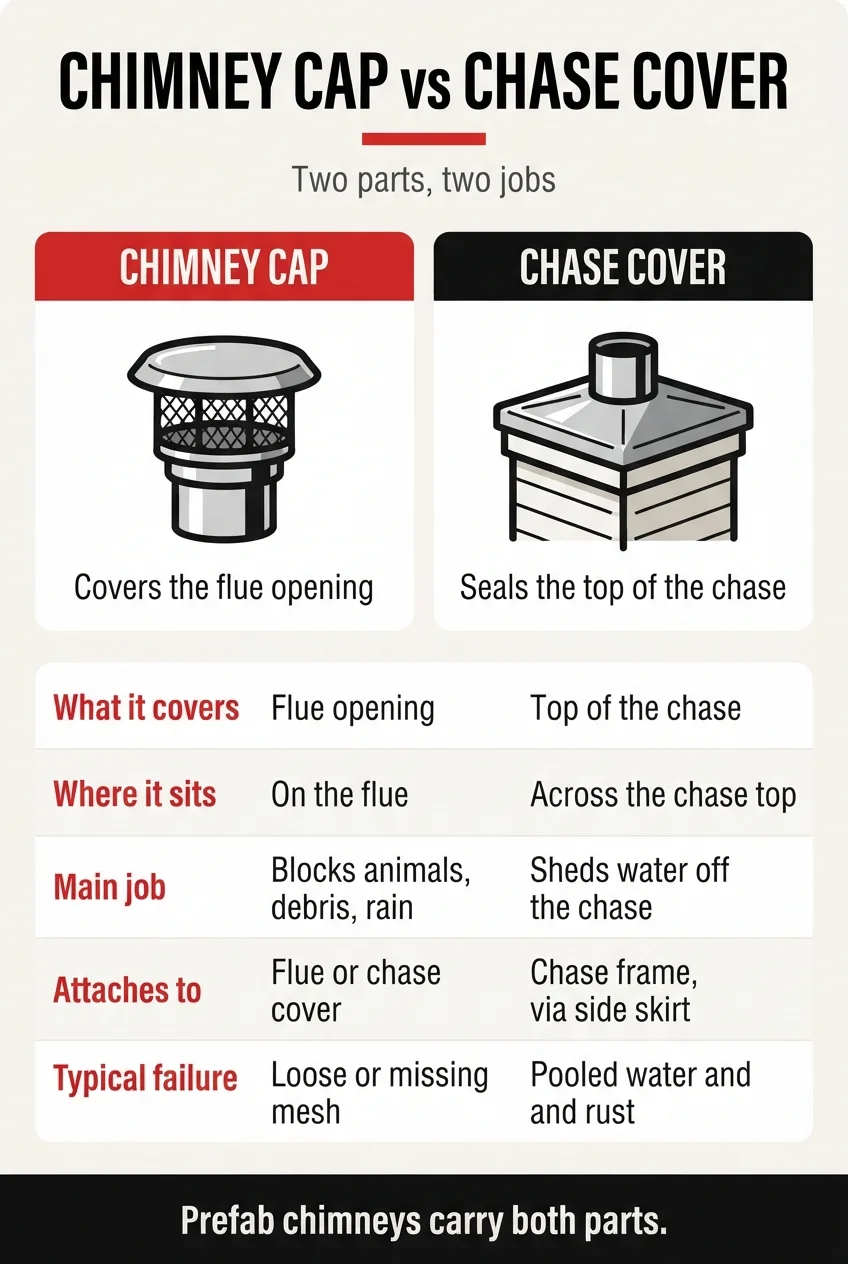
What is the difference between a chimney cap and a chase cover?
A chimney cap covers the flue opening and keeps out animals, rain, and debris. A chase cover is a metal pan that seals the top of a framed or factory-built chimney chase, and on a prefab chimney the cap attaches to it.
Both parts are metal, and either can fail while the other looks fine. A rusted chase cover can leak under a perfect cap.
What is another name for a chimney chase cover?
A chimney chase cover is also called a top pan, chase pan, or top flashing, and all three names describe the same metal pan that seals the top of a chimney chase. Some people also say chimney cover, which can mean a crown or a rain cap.
These terms come up when you compare chimney tops:
- Flue: the passage that carries smoke out of the house.
- Flue liner: the clay tile or metal pipe that lines the flue.
- Chase: the framed box, often wrapped in wood, metal, or vinyl siding, that encloses a factory-built chimney.
- Factory-built chimney: also called prefab, a metal flue pipe system made in a factory and installed inside a chase.
- Chimney cap: a metal hood with mesh sides that covers the flue opening.
- Crown: the concrete or mortar slab that seals the top of a masonry chimney.
- Damper: the movable plate that opens and closes the flue.
Chimney cap vs chase cover: 5 differences
The cap guards the opening, and the chase cover guards the structure around it.
| Difference | Chimney cap | Chase cover |
|---|---|---|
| What it covers | The flue opening | The whole top of the chase |
| Where it sits | On the flue liner or flue pipe | Across the top of the chase, with holes for the flue |
| Main job | Keeps animals, debris, and rain out of the flue | Keeps water off the top of the chase and out of the structure |
| What it attaches to | The flue tile, the crown, or on a prefab chimney the chase cover | The chase frame, through the side skirt |
| Typical failure | Loose, bent, missing, or rusted mesh | Pooled water, rust, and open seams |
Which chimneys have a chase cover?
Factory-built fireplaces and framed chases have chase covers. A traditional brick chimney has a crown instead.
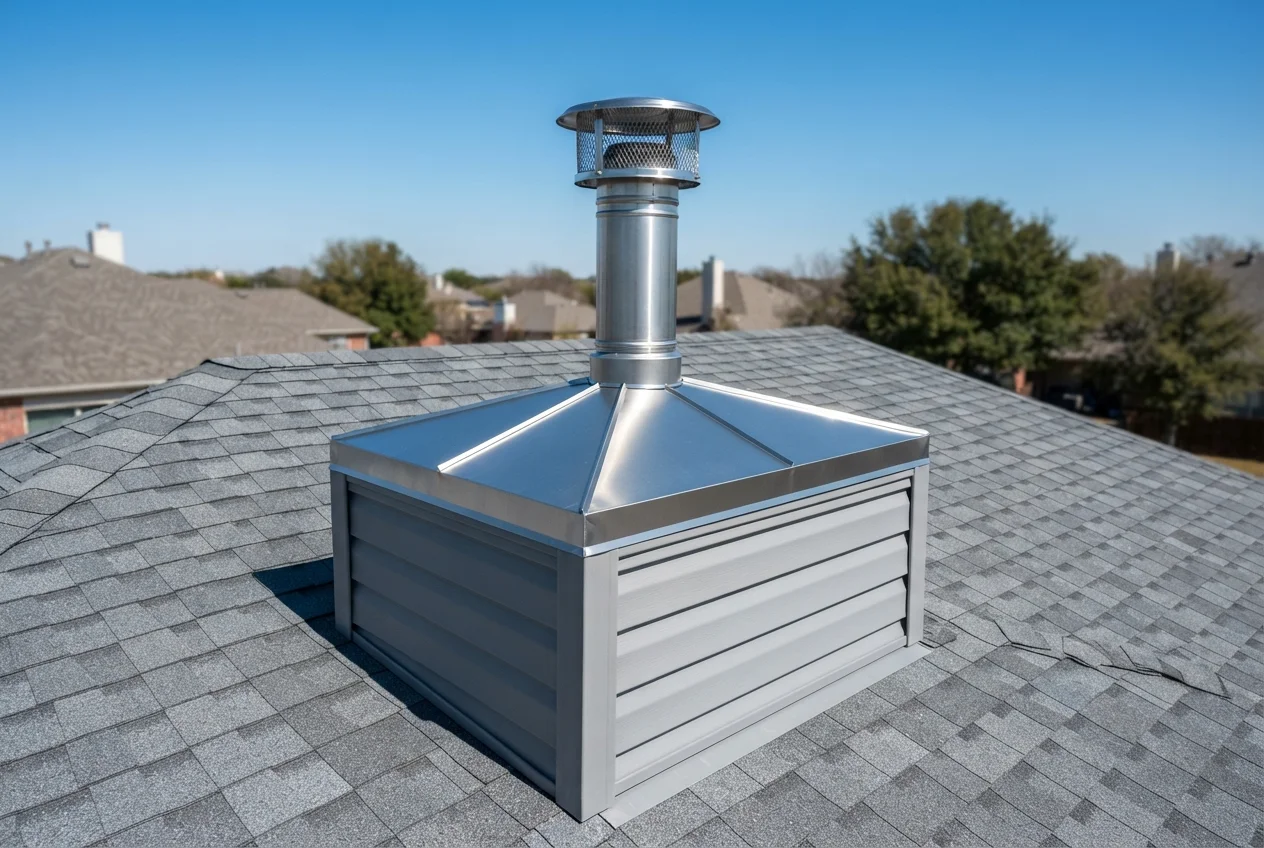
The chase cover sits flat across the top and has holes cut for each flue pipe. Because the chase is wrapped in siding, rust from a failing cover shows on the siding.
Telling a cap from a chase cover from the ground
Look at the siding
Siding or vinyl around the chimney means a framed chase with a chase cover. Brick or stone all the way up means a masonry chimney with a crown.
Look at the top
A flat metal lid wider than the flue is the chase cover. A small metal hood with mesh sides over the flue is the cap.
Binoculars or a phone zoom show most of this from the ground. Stay off the roof.
How the cap and chase cover work together
On a factory-built chimney, the cap sits on the flue pipe above the chase cover. The chase cover handles rain that lands on the chase, and the cap blocks what enters the flue.
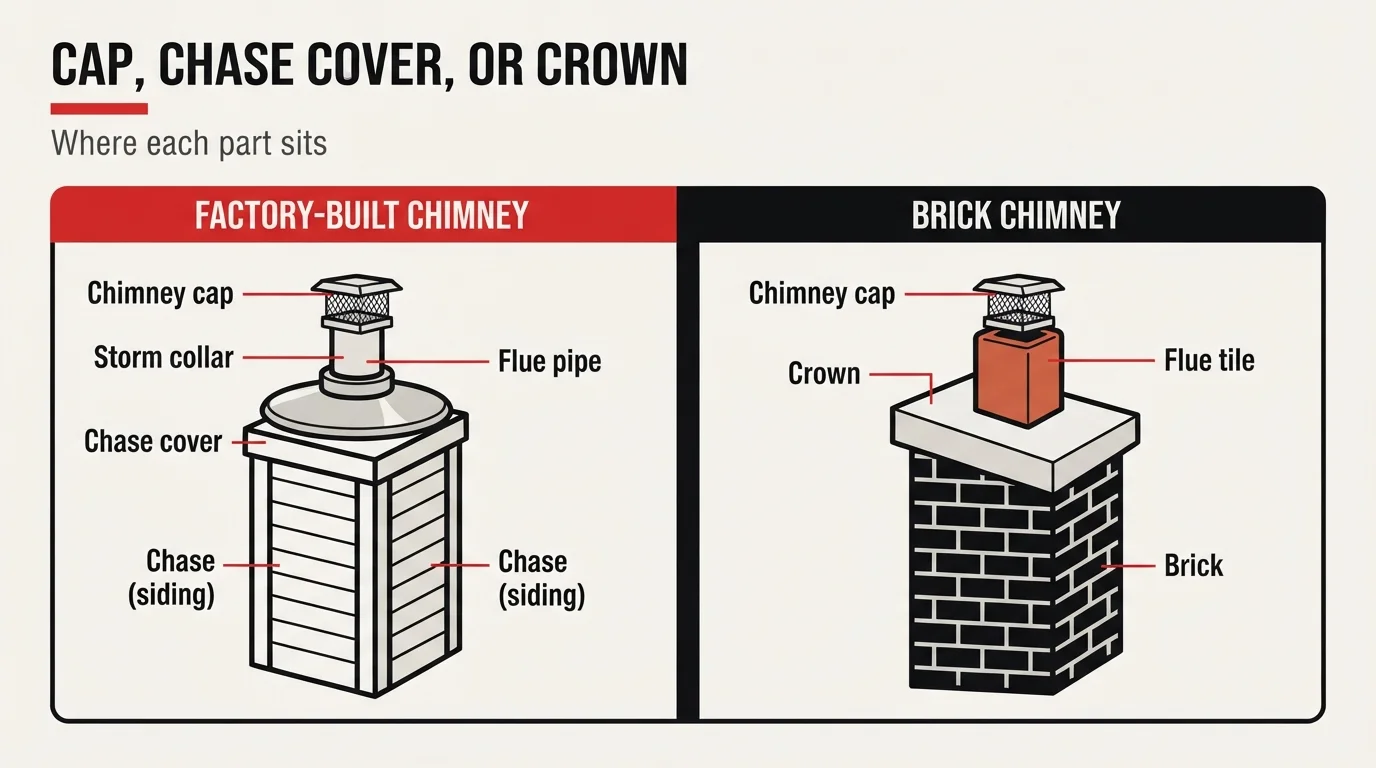
Neither part replaces the other.
What does a brick chimney use instead of a chase cover?
A brick chimney uses its crown in place of a chase cover. The crown slopes to shed water off the masonry.
The cap then sits on the flue liner or bolts to the crown, as This Old House describes. Our chimney cap types guide covers the styles.
A cracked crown lets water into the masonry the way a rusted chase cover lets water into a chase.
Chase cover materials
Chase covers are made from galvanized steel, stainless steel, or copper. Builder-grade covers are usually galvanized.
Galvanized steel rusts once its zinc coating wears through. A flat chase top gives water time to wear that coating down.
Stainless steel resists rust, though even stainless can break down in harsh conditions. Copper does not rust and develops a patina as it ages.
What makes a chase cover work
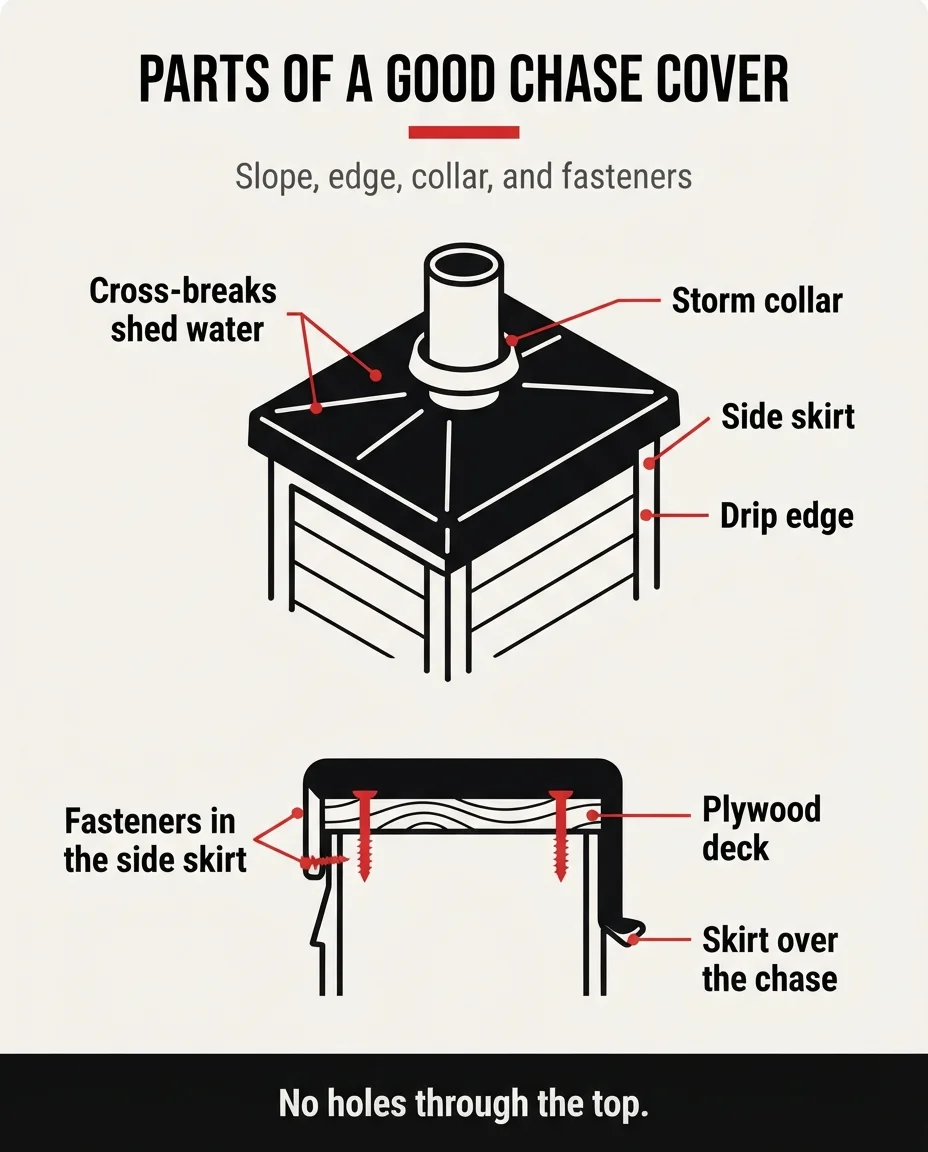
A chase cover works when it sheds water, seals the pipe opening, and stays fastened without holes in the top.
Slope and cross-breaks
Cross-breaks are diagonal creases pressed into the top that form a shallow dome. Rain runs off the dome instead of sitting on the metal.
A flat cover lets water pool at its low point. Pooled water causes rust stains and, over time, rust-through.
Drip edge and skirt
The skirt is the side flange that drops over the chase. A drip edge on the skirt makes water fall clear of the siding.
Many older covers have no drip edge. Rusty water then runs straight down the side of the chimney.
Storm collar
A storm collar is a ring around the flue pipe above the cover. It blocks water from entering the gap between the pipe and the cover.
Gauge and seams
Gauge measures sheet thickness, and a lower gauge number means thicker metal. One supplier recommends at least 24 gauge for a chase cover.
Welded seams are fused metal. Caulked seams rely on sealant, which can crack over time.
Fasteners and support
Fasteners belong in the side skirt, not through the top. Holes in the top become leak paths.
A stainless cover needs stainless screws, because plain screws rust and stain the siding. A plywood deck under the cover, with a hole cut for flue clearance, supports the metal.
Steel is the standard material on top of a chase. Roofing tar or asphalt sheet sags around the pipe and can drip into the house.
Seeing rust on your siding? Chimney Sweep Pro can tell you which part is failing. Call (682) 354-6644.
Cap, chase cover, or crown: which part is failing?
A chimney inspection confirms which part has failed. The table shows what each symptom usually points to.
| Symptom | Likely part | What it points to |
|---|---|---|
| Rust streaks on the siding | Chase cover | Pooled water and rust at the top edge |
| Standing water on top of the chase | Chase cover | A flat, dented, or sagging top |
| Rust flakes or water in the firebox | Chase cover, cap, or damper | Rust-through, or rain entering the flue |
| Animal sounds in the flue | Cap | Missing, bent, or loose mesh |
| Cap leaning or gone after wind | Cap | Failed fasteners or mounting |
| Cracks at the top of a brick chimney | Crown | Water entering the masonry |
What causes rust streaks on a chimney?
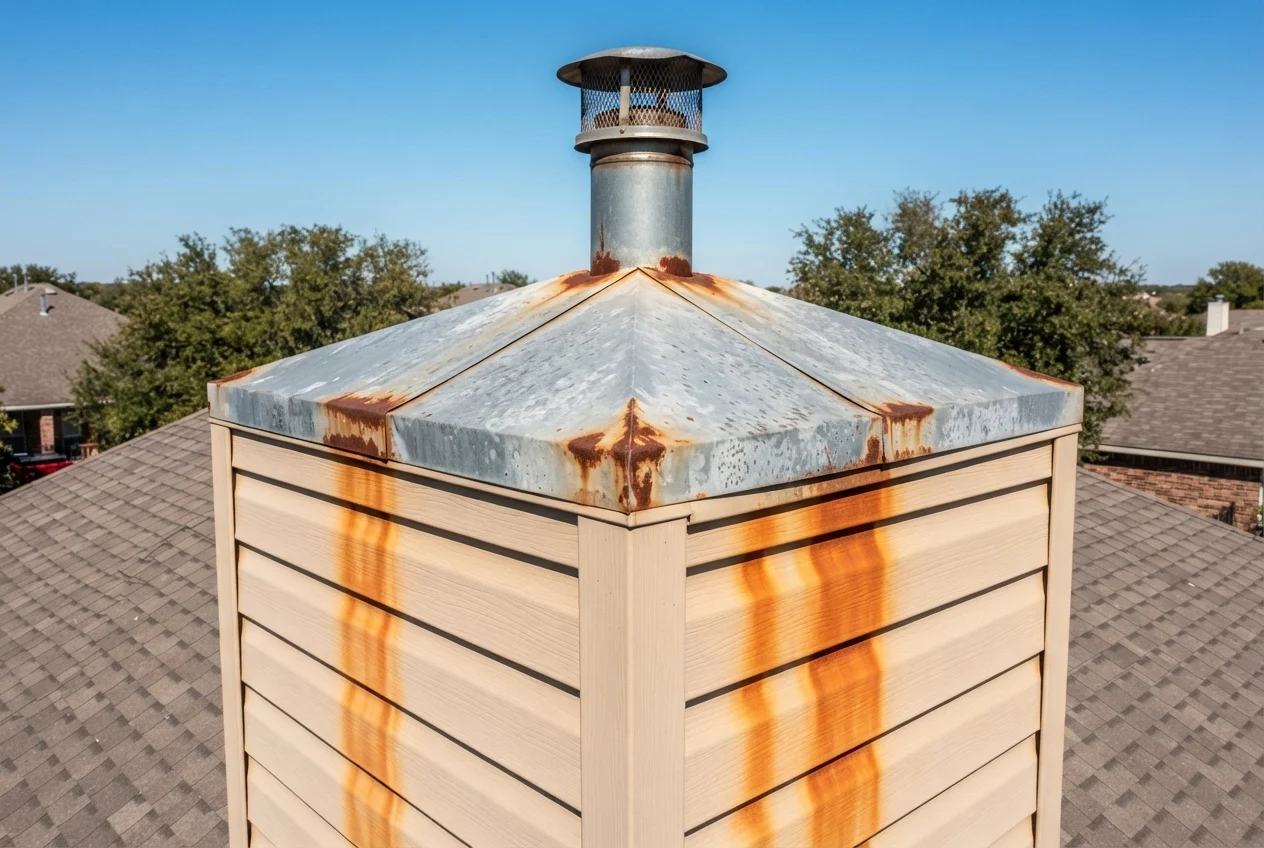
Rust streaks on a chimney usually come from the chase cover, because water pools on a flat or worn pan, rusts the metal, and runs down the siding. A pan without a drip edge sends that rusty water straight down the side.
Standing water on top of the chase
Standing water means the top does not drain. A flat, dented, or sagging pan holds water against the metal and speeds up rust.
Rust flakes or water in the firebox
The firebox is the part of the fireplace where the fire burns. Rust flakes there mean a rusted part above is shedding down the flue, and the source could be the pan, the cap, or the damper.
Water in the firebox is a leak. Schedule chimney leak repair.
Animal sounds in the flue
Mesh on the cap is what keeps animals out. Bent mesh or a loose cap opens a path into the flue.
Cap leaning or gone after wind
A cap holds on its fasteners. Failed fasteners let wind lift or shift it.
Cracks at the top of a brick chimney
Cracks in the crown let water into the masonry below. The crown does the chase cover’s job on brick, so a crack there is a failure of the same kind.
How do I know if I need a chase cover?
You need a chase cover if your chimney is a framed chase, usually wrapped in siding around a factory-built fireplace, while a brick or stone chimney uses a crown instead. Rust streaks down the siding or water pooling on top mean the chase cover needs attention.
Chimney cap vs chase cover in Fort Worth homes
Fort Worth weather works on both parts, and the chase cover takes the most direct hit because it is a large, flat sheet.
Hail
Hail dents thin sheet metal. A dent in a flat pan holds water.
Summer heat
Summer heat expands and shrinks the metal every day. That cycle can crack the sealant bead around the edges over time.
Which homes have which part
Newer neighborhoods such as Benbrook more often have factory-built fireplaces in framed chases, so a chase cover is part of the roofline. Older Fairmount homes more often have masonry chimneys, which have a crown instead.
What a professional checks at the top of a chimney
A professional checks the chase cover, the cap, the flue pipe where it passes through the cover, and the sealant and fasteners. The technician also measures the pan, the chase, and the flue opening before any replacement.
Ask any chimney company whether its technicians hold CSIA certification. CSIA is the Chimney Safety Institute of America, a nonprofit that certifies chimney sweeps.
When to call a chimney professional
Call a professional when rust streaks run down the siding, water stands on top of the chase, rust flakes or water show up in the firebox, or water stains appear near the fireplace.
- Emergency: If a carbon monoxide alarm sounds, get everyone outside and call 911 before calling anyone else. Do the same for smoke or fire inside the house.
- Soon: Active water entry, standing water on the pan, and rust-through belong here.
- Can wait: Surface rust staining with no leak and no pooled water can wait until your next inspection.
Telling the parts apart is a ground-level task. Roof work belongs to a professional because of the fall risk.
For crown and masonry problems, see our chimney repair page.
Chimney Sweep Pro inspects the top of your chimney and handles chimney cap installation in Fort Worth and nearby cities such as Keller and Saginaw. Whichever part you suspect, call (682) 354-6644 and we will work out which one it is.