
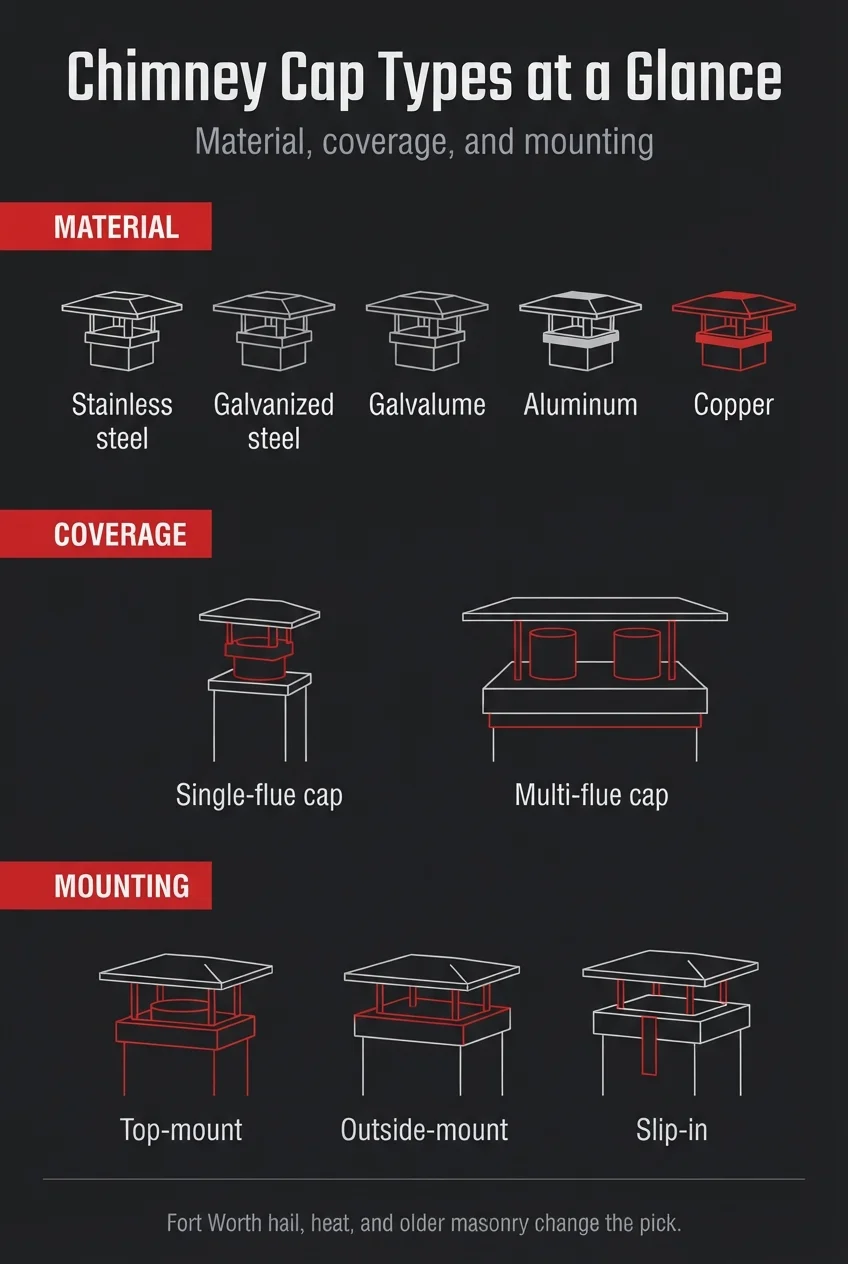
Chimney cap types come down to three choices: the metal, how many flues the cap covers, and how it mounts. Fort Worth hail, summer heat, and older masonry change which choice fits your chimney.
Not sure which cap suits your chimney? Chimney Sweep Pro can help you sort it out. Call (682) 354-6644.
What are chimney caps made of?
Chimney caps are made from stainless steel, galvanized steel, aluminum, or copper, and each metal wears in its own way. Stainless steel and copper need little upkeep, galvanized steel depends on its coating, aluminum dents easily, and copper changes color as it ages.
A chimney cap is a metal cover over the flue, the passage that carries smoke out of the house. It keeps rain, animals, and debris out of that opening.
A cap can cover one flue or the whole crown, the concrete or mortar slab that tops the masonry.
Three ways to sort chimney cap types
Every cap falls into three categories: material, coverage, and mounting. Material is the metal, and coverage is how many flues one cap protects.
Mounting is how the cap attaches to the chimney.
Chimney cap materials compared
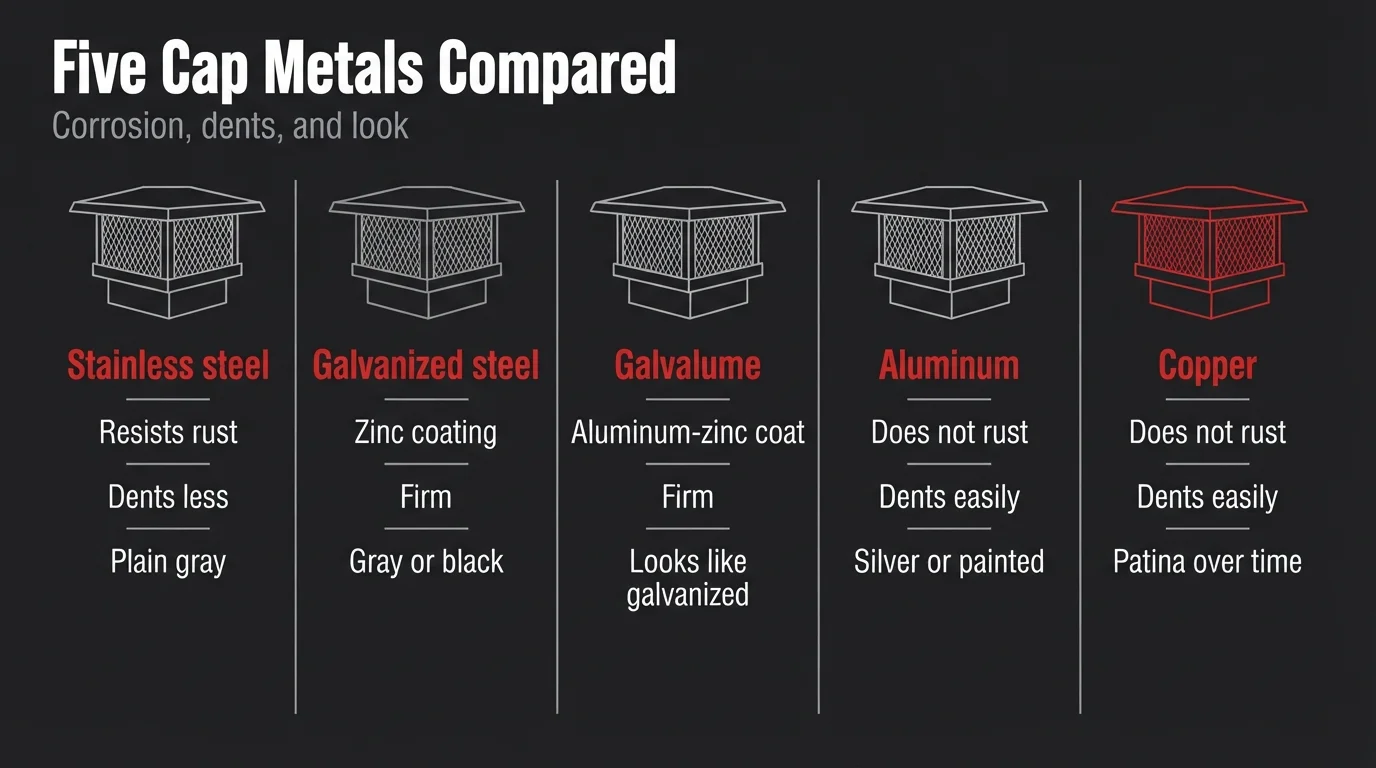
The metals you will see most often are stainless steel, galvanized steel, Galvalume, aluminum, and copper. The table sorts them by how they resist corrosion, how they dent, how they look, and how they fit Fort Worth weather.
| Material | Corrosion behavior | Dent resistance | Look | Fort Worth fit |
|---|---|---|---|---|
| Stainless steel | Resists rust; 304 is the common grade | Firm; dents less than aluminum or copper | Plain metal gray | Suits hail and summer heat |
| Galvanized steel | Zinc coating protects the steel until it wears through | Firm | Gray, or black powder coat | Sound until the coating breaks |
| Galvalume | Aluminum-zinc coating over steel | Firm | Looks like galvanized steel | Similar to galvanized; coating claims come from makers |
| Aluminum | Does not rust | Soft; dents easily | Silver or painted shades | Hail dents it |
| Copper | Does not rust; darkens, then turns green | Soft; dents more easily than steel | Reddish orange, then patina | Chosen for looks; hail can dent it |
Price depends on the metal, the size, and the labor. The cost factors are laid out in our post on chimney cap installation cost.
Stainless steel chimney caps
Stainless steel resists rust because chromium in the alloy forms a thin protective layer on the surface. Grade 304 is the common alloy for caps.
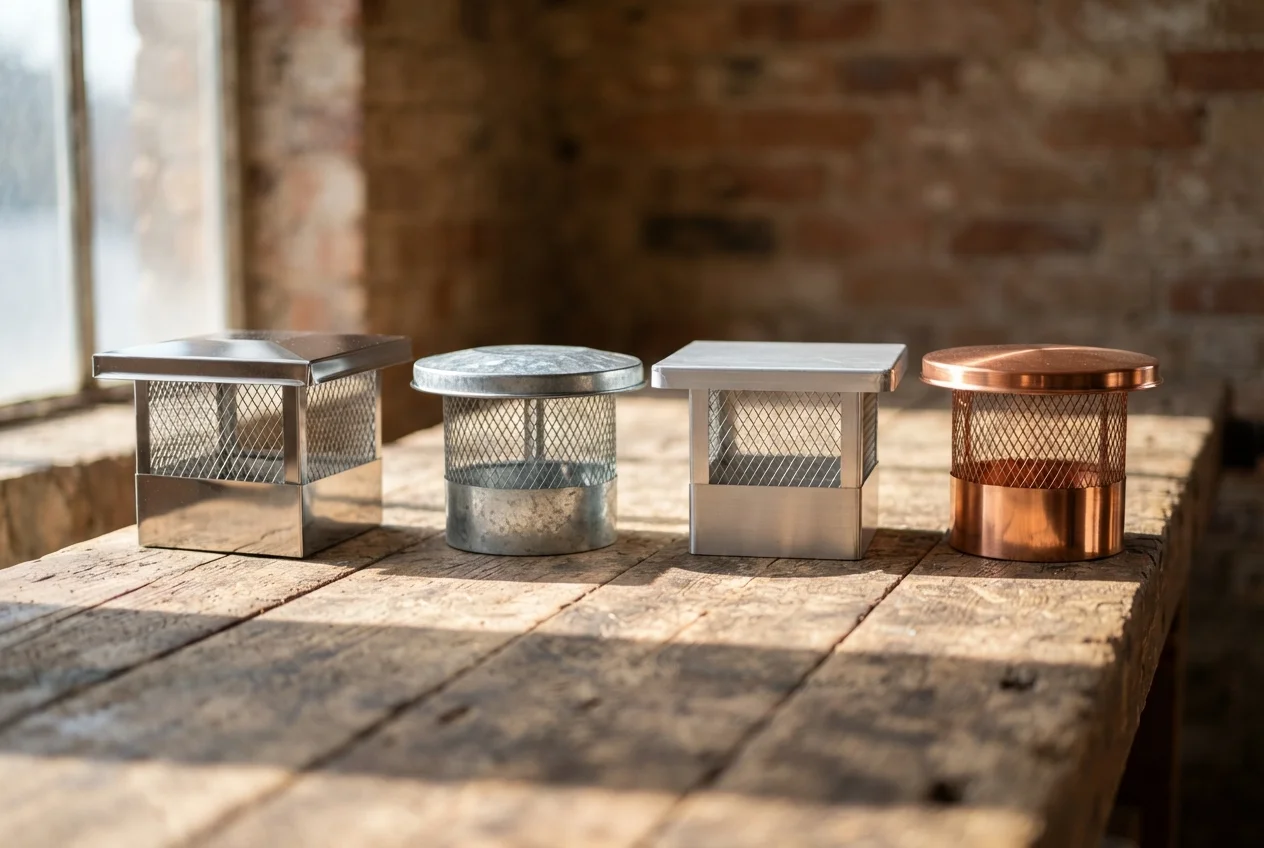
The finish is a plain metal gray, so color choices are limited. Gauge measures sheet thickness, and a lower gauge number means thicker metal.
CSIA’s director of education told Family Handyman that stainless steel and copper caps need very little maintenance. CSIA is the Chimney Safety Institute of America, a nonprofit that certifies chimney sweeps.
Wind or a fallen limb can still damage any cap. You can often spot that damage from the ground, and our guide to the signs a chimney cap needs replacing lists what to look for.
Some custom sheet-metal shops recommend soldering the seams on stainless and copper caps.
Galvanized steel chimney caps
Galvanized steel is regular steel coated in zinc. The zinc protects the steel until scratches, cut edges, or wear break through it.
Once the coating fails, the steel underneath rusts. Rust starts where the coating is thinnest, usually at cut edges and bends.
Black powder-coat finishes add a second layer over the zinc.
Galvalume chimney caps
Galvalume is steel coated with an aluminum-zinc alloy instead of zinc alone. It looks much like galvanized steel.
Manufacturers describe it as more corrosion resistant than galvanized steel and say it protects itself at small scratches. Those are manufacturer claims, so ask the supplier for the specific coating warranty.
Aluminum chimney caps
Aluminum does not rust, but it is soft. Hail and impacts dent it, and a dented cap can lose its seal against the flue tile.
Aluminum is light and often painted in bronze, white, or black shades to match trim.
Copper chimney caps
Copper does not rust, and it changes color as it ages. New copper is reddish orange, and over time it turns dark brown and then green.
Copper is soft, so hail can dent it. Homeowners care most about appearance on chimneys that face the street.
Comparing metals for your roof? Chimney Sweep Pro can walk you through the options. Call (682) 354-6644.
Single-flue chimney caps
A single-flue cap covers one flue opening and attaches to the flue liner, the clay tile or metal tube that lines the flue. It is the most common style.
Many sit on top of the tile and bolt at the corners, as This Old House describes. A tight fit around the tile matters because gaps let in water and animals.
How many chimney caps does one chimney need?
One cap is needed for each flue, or one multi-flue cap covers all of them. A chimney with two flues set far apart usually takes two single-flue caps. Flues set close together usually take one large cap that bolts to the crown.
A multi-flue cap, also called a full-coverage cap, is custom-sized to cover the entire crown. It protects the masonry as well as every flue under it.
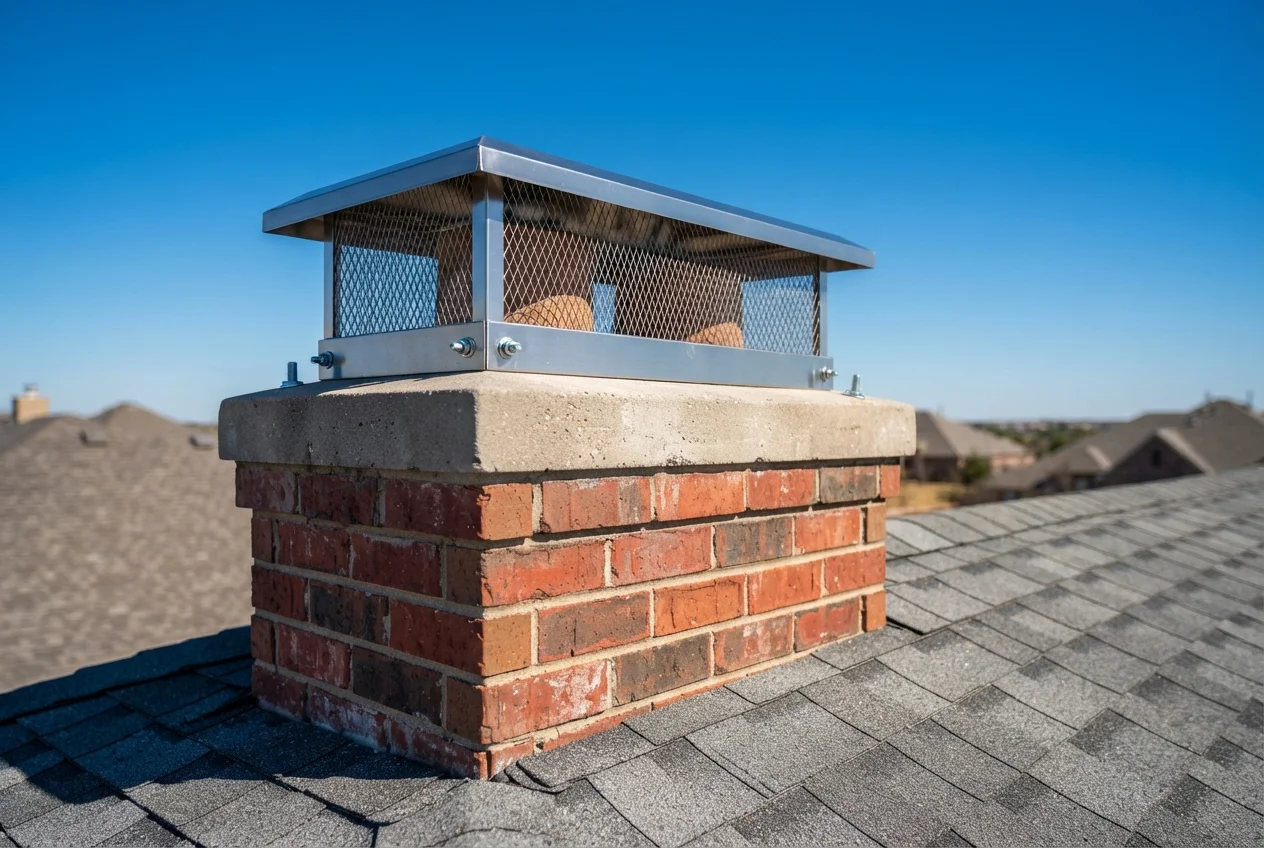
The crown must be sound before a multi-flue cap bolts to it. A cracked crown should be repaired first.
Top-mount, outside-mount, and slip-in caps
Mounting decides how a cap attaches, and each method suits a different chimney top.
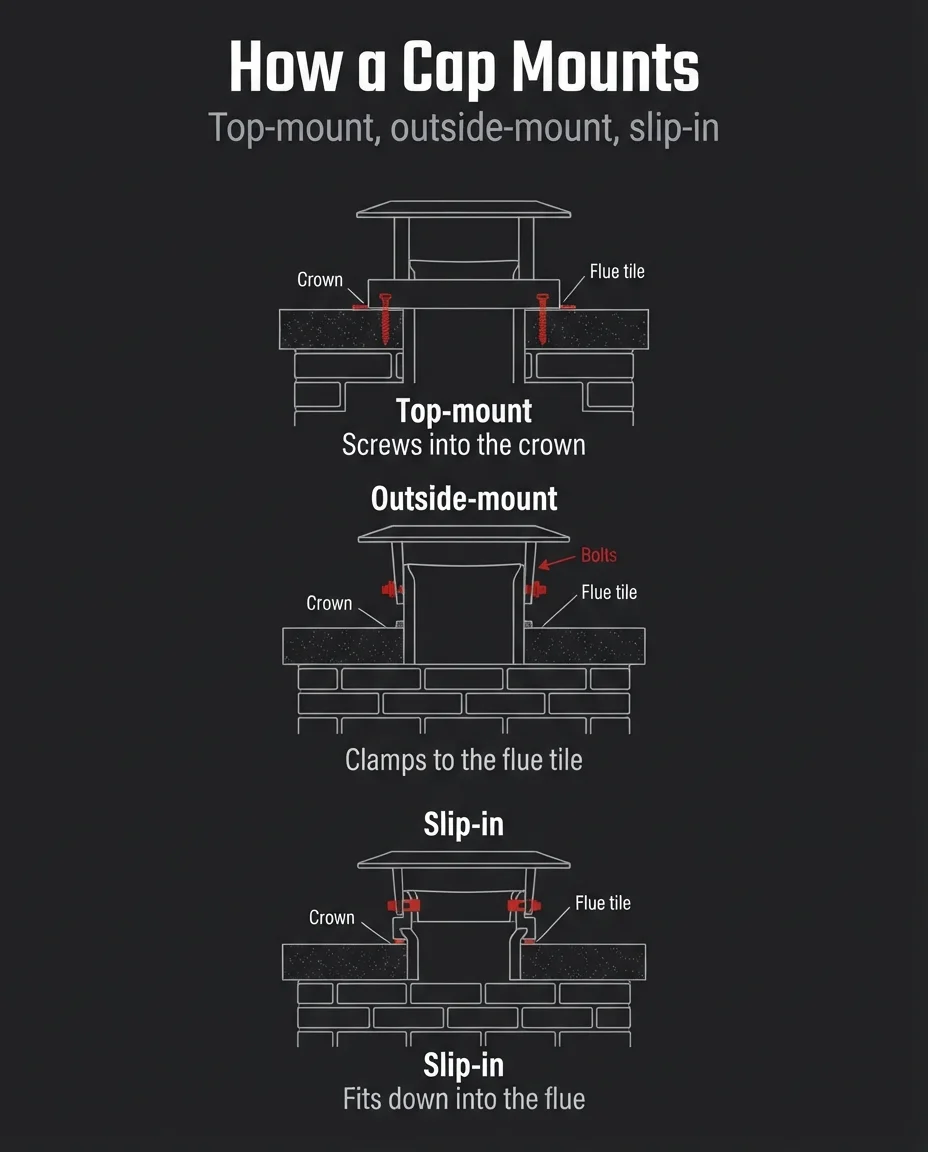
Top-mount caps
Top-mount caps screw into the crown masonry with masonry screws. A bead of silicone caulk seals the base.
Outside-mount caps
Outside-mount caps clamp or bolt to the outside of the flue tile. The tile must be intact enough to hold the bolts.
Slip-in caps
Slip-in caps fit down into the flue opening and hold with clamps or screws. They need an opening with a clean, uniform shape.
A weak fastener can let any mounting type lift in strong wind.
Specialty chimney caps
Specialty caps solve one problem: draft, meaning how air moves up the flue.
- Wind-directional caps suit chimneys exposed to heavy wind or in need of help with updraft.
- Draft-increasing caps are built to improve airflow up the flue.
- Electric caps use an adjustable fan to control draft.
- Flue extenders raise the flue opening so smoke clears the roofline.
Caps that combine a damper with the cap also exist, and our guide to top-sealing damper vs chimney cap compares them.
Chimney cap mesh and spark arrestors
The mesh around a cap keeps animals and large debris out of the flue. It also works as a spark arrestor, a screen that stops hot embers from leaving the chimney.
Cap mesh is usually expanded metal or welded wire. Mesh size is set by local code and the fuel you burn.
Tighter mesh stops smaller embers but clogs faster and slows airflow. Wider mesh moves air easily but lets larger embers through.
Ask your chimney professional which size your code requires.
What type of chimney cap works on a brick chimney?
Pick the cap that fits tightly over the top of the chimney. Brick chimneys take caps that sit on the flue tile or bolt to the crown. A loose cap lets in water and animals, and the table below matches each chimney type to its usual cap.
| Chimney type | Cap that usually fits | Reason |
|---|---|---|
| Masonry, one clay-tile flue | Single-flue cap | Sits on or bolts to the flue tile |
| Masonry, two or more flues | Multi-flue cap, or one single-flue cap per flue when flues are spaced apart | A full-coverage unit also shields the crown |
| Masonry with a metal liner | Cap sized to that liner | Liner size and shape set the cap size |
| Prefab fireplace with a metal chimney | A cap on the flue pipe, attached to the chase cover | The chase cover seals the top of the chase, and the cap attaches to it |
Which chimney cap material suits Fort Worth weather?
Stainless steel dents less in hail and resists rust, which suits North Texas storms and summer heat. Aluminum and copper are softer and dent more easily. Galvanized steel works until its coating wears through, and gauge matters as much as the material.
Hail
Hail dents soft metals first. Thin sheet of any metal gives way faster than thick sheet.
Summer heat
Summer heat expands and shrinks the metal every day. That cycle can loosen fasteners and soldered joints over time, one way a chimney cap blew off after a storm.
Freeze and thaw
Water that gets past a damaged cap can freeze and thaw in a Fort Worth winter. That cycle cracks masonry and liners, and CSIA’s director of education has made the same point about water in chimneys.
Older homes in Fairmount
Older homes in Fairmount often have masonry stacks with more than one flue. Those chimneys are the usual candidates for a multi-flue cap.
Water in the firebox
The firebox is the part of the fireplace where the fire burns. Water there means rain is getting past the cap, so schedule chimney leak repair.
When to call a chimney professional
Call a professional when the cap is loose, leaning, missing, or rusted through. Call when you hear animals in the flue or find water in the firebox.
- Emergency: If a carbon monoxide alarm sounds, get everyone outside and call 911 before calling anyone else. Do the same for smoke or fire inside the house.
- Soon: A loose, leaning, or missing cap, animal noises, and nesting debris in the flue belong here. Do not light a fire until a professional checks the flue.
- Can wait: Surface rust, a color change, and small dents that leave the cap seated can wait until your next inspection.
A professional measures the flue opening, checks the crown for cracks, and identifies the liner type before choosing a cap. Choosing a cap is a job you can do from the ground. Climbing a roof to remove or fasten one is a fall risk, so leave it to a professional.
Chimney Sweep Pro handles chimney cap installation in Fort Worth and nearby cities such as Keller and Saginaw. Whichever chimney cap types you are weighing, call (682) 354-6644 and we will confirm the fit before you buy.