
A dryer taking too long to dry most often has a restricted vent, but it can also be a full lint screen, an overloaded drum, a wet load from the washer, or a failing part. A five-minute test separates the vent from everything else.
Chimney Sweep Pro cleans dryer vents for Fort Worth homeowners from our base in Saginaw, TX. If the vent turns out to be the problem, call (682) 354-6644.
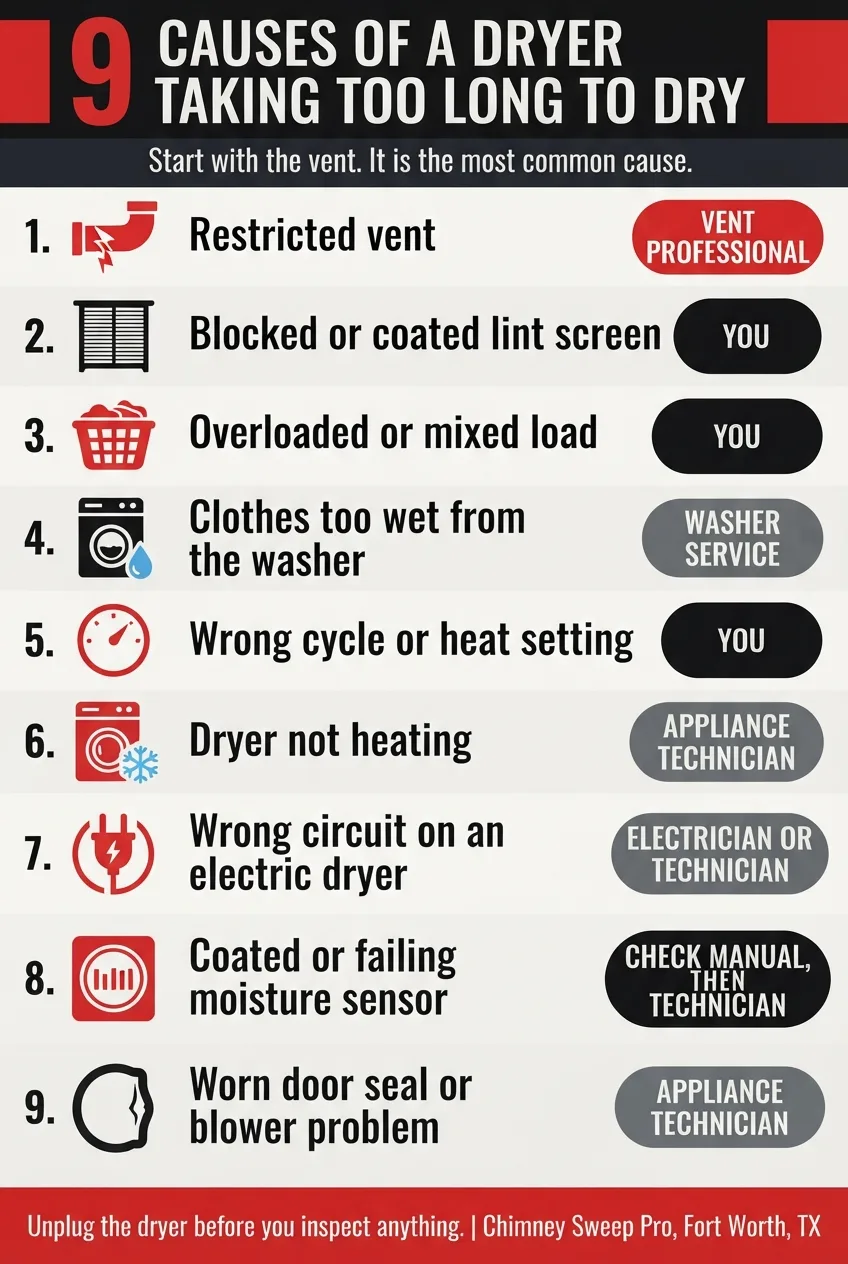
Dryer taking too long to dry: causes at a glance
A dryer takes too long to dry when air cannot leave the drum, the load is too big or too wet, or a part is not heating. A restricted vent is the most common cause. Test the vent and the heat first, then look at the load.
| Cause | How to tell | Who fixes it |
|---|---|---|
| Restricted vent | Weak airflow at the exterior hood | Vent professional |
| Blocked or coated lint screen | Lint or a film on the screen | You |
| Overloaded or mixed load | Packed drum, or towels dried with light clothes | You |
| Clothes too wet from the washer | Water wrings out after the wash cycle | Washer service |
| Wrong cycle or heat setting | Low heat or a cycle that ends early | You |
| Dryer not heating | The drum stays cool or barely warm | Appliance technician |
| Wrong circuit on an electric dryer | The dryer runs, but dry times are far longer | Electrician or appliance technician |
| Coated or failing moisture sensor | The dryer stops early or runs long | You check the manual, then a technician |
| Worn door seal or blower problem | Air escapes at the door, or airflow inside is weak | Appliance technician |
Each cause is explained below. Start with the test in the next section.
How do you tell a vent problem from a dryer problem?
Run the dryer on a heated cycle and check two things: whether the drum gets hot and whether air reaches the outside hood. Good heat with weak airflow points to the vent, and weak heat points to the dryer.
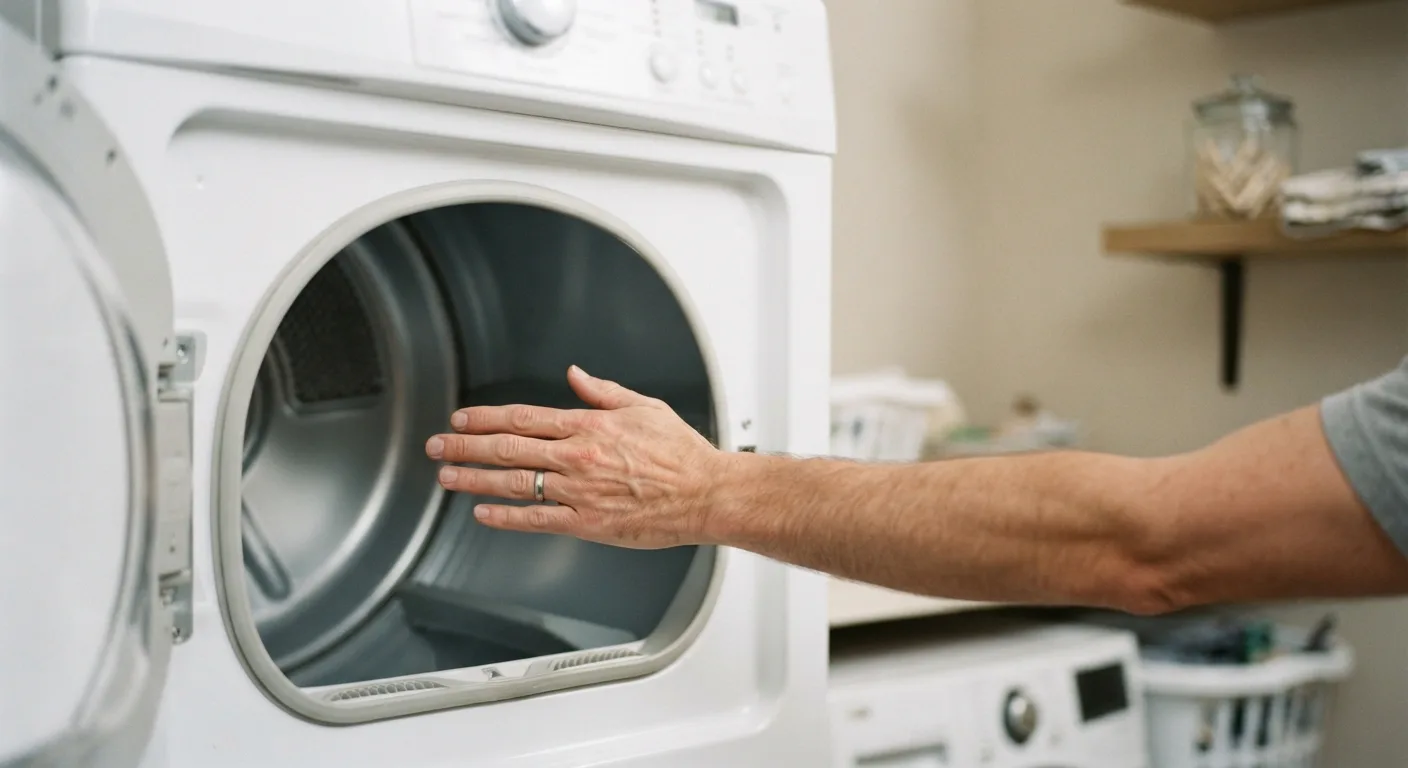
Maytag’s product help suggests running an empty dryer for five minutes to confirm it heats.
- Run the dryer empty on a heated cycle for five minutes. Check that the drum warms up.
- Go outside and find the exterior hood. The flap should open, and warm air should come out.
- Compare the two results. Use the four outcomes below.
The airflow check at the hood is explained in the guide to the signs of a clogged dryer vent.
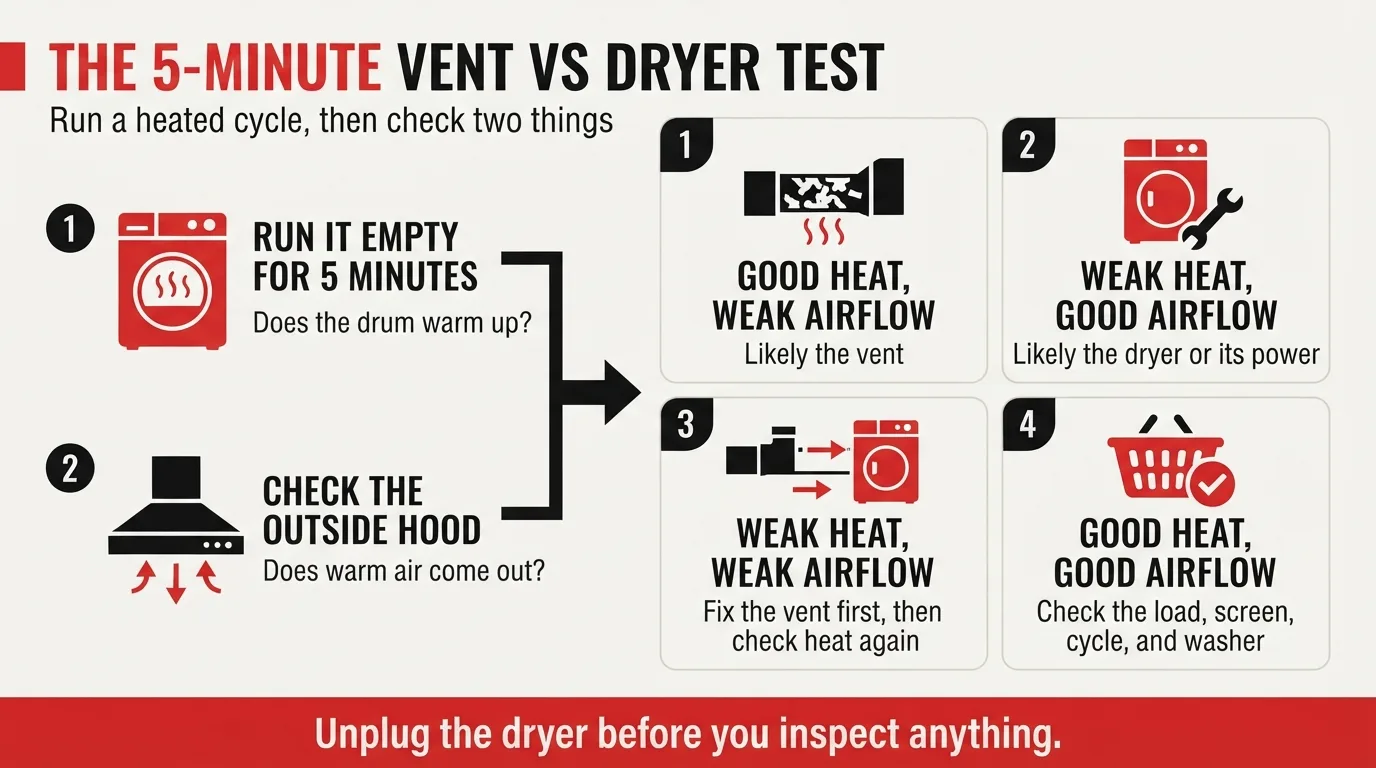
Good heat, weak airflow
The vent is the likely cause. The dryer makes heat, but the moist air cannot leave.
Clean the lint screen first, then call a vent professional.
Weak heat, good airflow
The dryer or its power supply is the likely cause. Unplug the dryer and call an appliance technician.
Weak heat and weak airflow
Two problems may overlap. Fix the vent first, then check the heat again.
Good heat and good airflow
Look at the load, the lint screen, the cycle setting, and the washer. Those causes are explained below.
Weak airflow at the hood? Chimney Sweep Pro can find and clear the blockage. Call (682) 354-6644.
What causes a dryer to take too long to dry?
Nine causes explain most slow dryers. A vent professional fixes the first, and the rest split between you and a technician.
Restricted or clogged vent
A restricted vent is the most common cause of long dry times. Lint and debris narrow the duct, so humid air cannot leave the drum.
Maytag’s product help lists poor ventilation among the leading causes and says weak airflow outside points to a restricted vent path. Whirlpool also advises checking that the vent hose behind the dryer is not crushed.
A vent professional clears this. The guides to how often to clean a dryer vent and dryer vent length and routing explain the schedule and the layouts that clog fastest.
A crushed or unsuitable duct restricts airflow the same way, as the guide to foil vs rigid dryer duct explains.
Blocked or coated lint screen
A lint screen blocked with lint or coated with a film slows drying. Fabric softener sheets can leave residue that is not always visible.
Maytag advises washing the screen with warm water and a soft brush, then drying it fully before you put it back.

Overloaded or mixed loads
An overloaded drum traps moist air and slows drying. Towels and heavy items mixed with lightweight clothes also extend the cycle.
Split large loads and dry heavy items separately.
Clothes too wet from the washer
Clothes that come out of the washer soaking wet take far longer to dry. If water wrings out of a load after the wash cycle, the washer may need service, according to GE Appliances.
Check that you selected the right spin setting first.
Wrong cycle or heat setting
The wrong cycle or a low heat setting lengthens drying. Maytag advises choosing an automatic cycle for best performance, or a different cycle such as Regular if clothes are not dry enough.
Dryer not heating
A dryer that tumbles without heating takes a very long time to dry. On an electric dryer, repair sites point to a failed heating element, and on a gas dryer to an igniter or gas valve problem.
A blown thermal fuse can also stop the heat. These are repairs for an appliance technician, so do not open the cabinet yourself.
If you smell gas near a gas dryer, leave the house and call the gas company or 911.
Wrong circuit on an electric dryer
An electric dryer on a 120-volt circuit instead of a 240-volt circuit can take as much as three times longer to dry, according to GE Appliances.
Have a licensed electrician or appliance technician check the circuit.
Coated or failing moisture sensor
A moisture sensor coated with residue can misread how wet the clothes are. The dryer may then stop early or run longer than needed.
Sensors are usually thin metal bars inside the drum. Check your manual for how to clean them, and call a technician if the problem stays.
Worn door seal or blower problem
A worn door seal lets air leak, and a blocked or failing blower wheel weakens airflow inside the dryer. Both slow drying, and both are technician repairs.
Why is your dryer hot but the clothes stay damp?
A dryer that is hot but leaves clothes damp usually cannot move moist air out. A restricted vent is the most common reason, and a crushed or unsuitable duct does the same.
The hood test above tells you whether the vent is the cause.
Why does your dryer need two cycles to dry a load?
A dryer that needs two cycles has a cause from the table above, and the vent is the first one to check. Loads that once dried in one cycle and now need two are a sign worth acting on.
Run the five-minute test, then look at the load size, the lint screen, and the washer.
Who should you call: a vent professional or an appliance technician?
Call a vent professional when airflow is weak at the hood, and an appliance technician when the dryer is not heating or shows error codes. A vent professional cleans and inspects the vent, and an appliance technician repairs the dryer.
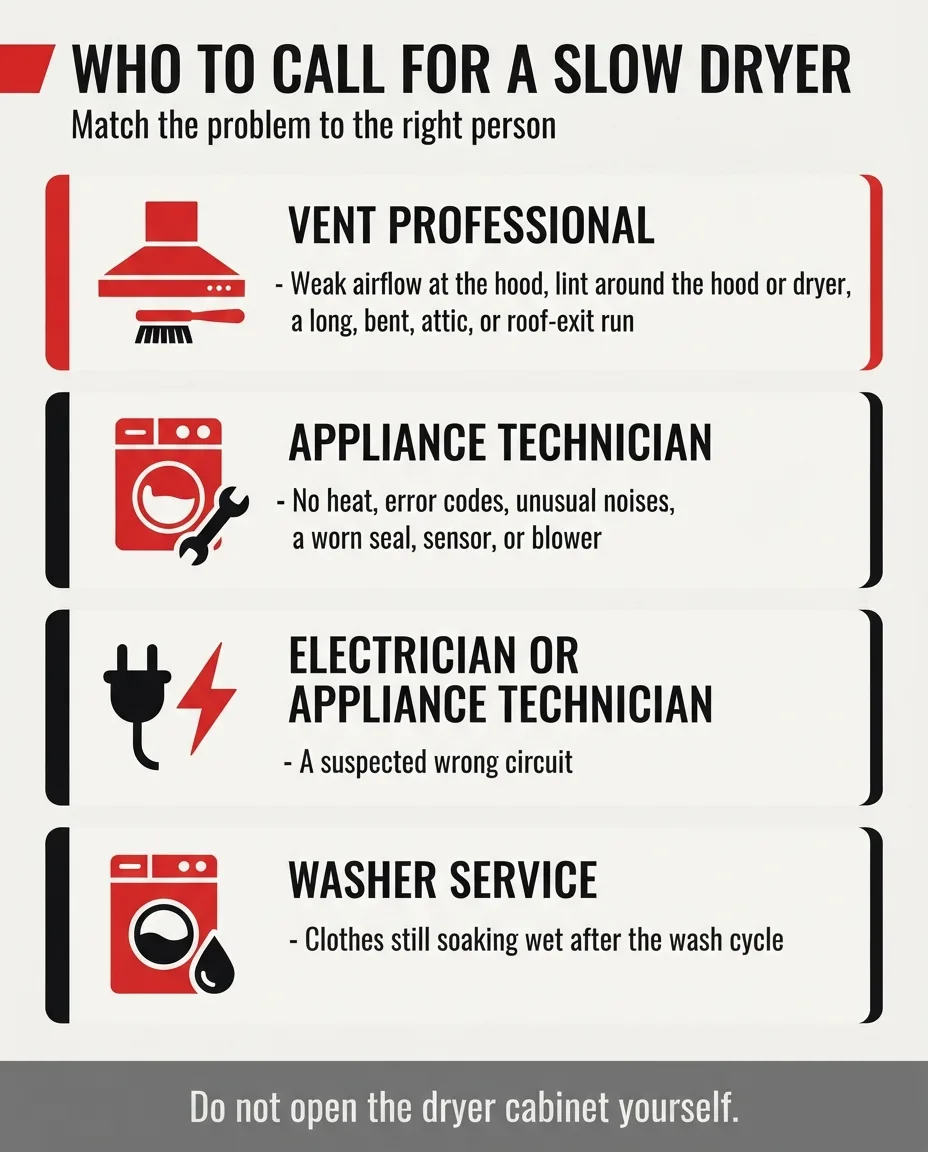
- Vent professional: weak or no airflow at the hood, lint around the hood or dryer, a long, bent, attic, or roof-exit run, or a duct you cannot see.
- Appliance technician: no heat, error codes, unusual noises, or a worn seal, sensor, or blower.
- Electrician or appliance technician: a suspected wrong circuit.
- Washer service: clothes that stay soaking wet after the wash cycle.
Maytag says to arrange service if long dry times persist after cleaning, the dryer does not heat, error codes appear, or unusual noises occur.
If the hood test points to the vent, the guide to DIY vs professional dryer vent cleaning explains what you can clear yourself and what needs a professional.
What should you tell whoever you call?
Share what you found so the visit starts in the right place.
- The result of the five-minute test: heat and airflow.
- How long a normal load takes now.
- Whether the lint screen is clean.
- Whether the load size and the wash cycle are normal.
What safety steps should you take while troubleshooting a slow dryer?
Unplug the dryer before you inspect anything, according to Maytag and GE Appliances. Do not open the cabinet, because internal parts are for a technician.
A burning smell or a dryer that shuts off early is urgent. Stop the dryer, and for smoke or flames follow the steps in the guide to dryer vent fires.
Dryer taking too long to dry in Fort Worth homes
Some Fort Worth homes route the dryer vent through the attic to a roof exit. Homes with an interior or upstairs laundry room often need longer runs than homes with the dryer on an exterior wall.
Long runs give lint more places to settle, so slow drying is often a vent problem there. Windblown debris and pests can also block the exterior hood in the Fort Worth area.
When to call a professional about a dryer taking too long to dry in Fort Worth
Call a vent professional when the hood test shows weak airflow, or when a clean lint screen and a normal load do not fix the slow drying.
Chimney Sweep Pro provides dryer vent cleaning in Fort Worth for homeowners in Fort Worth and nearby areas.
For a dryer taking too long to dry because of the vent, call (682) 354-6644 and have it found and cleared.