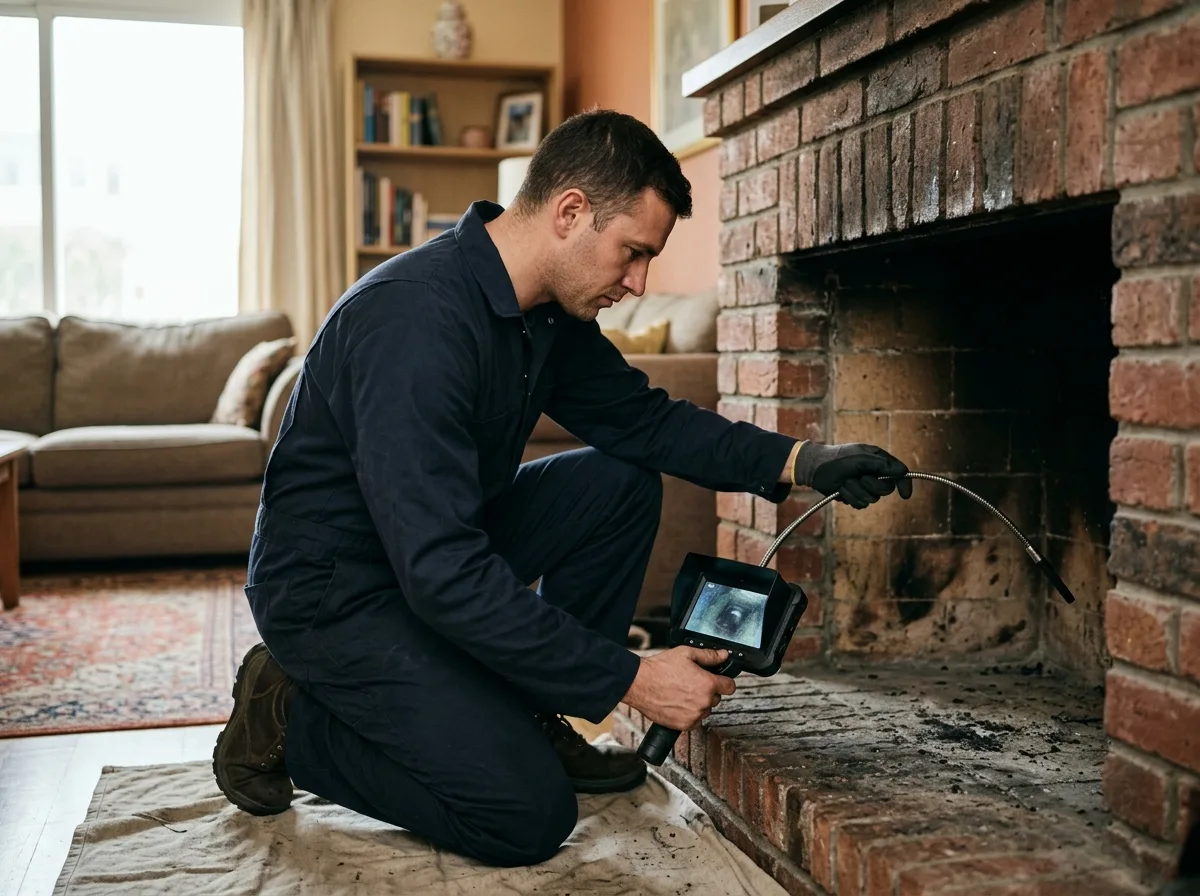
Level 1 is the routine inspection for a chimney that hasn’t changed. Level 2 adds a camera scan inside the flue, the passage that carries smoke out of the house, and covers attics, crawlspaces, and basements. Level 3 is invasive and used only when a hidden hazard is suspected.
Most Fort Worth homeowners need a Level 1 each year. A Level 2 applies when you buy or sell, change the fuel or appliance, reline the chimney, or deal with a fire or storm.
Not sure which one applies to you? Chimney Sweep Pro can tell you. Call (682) 354-6644.
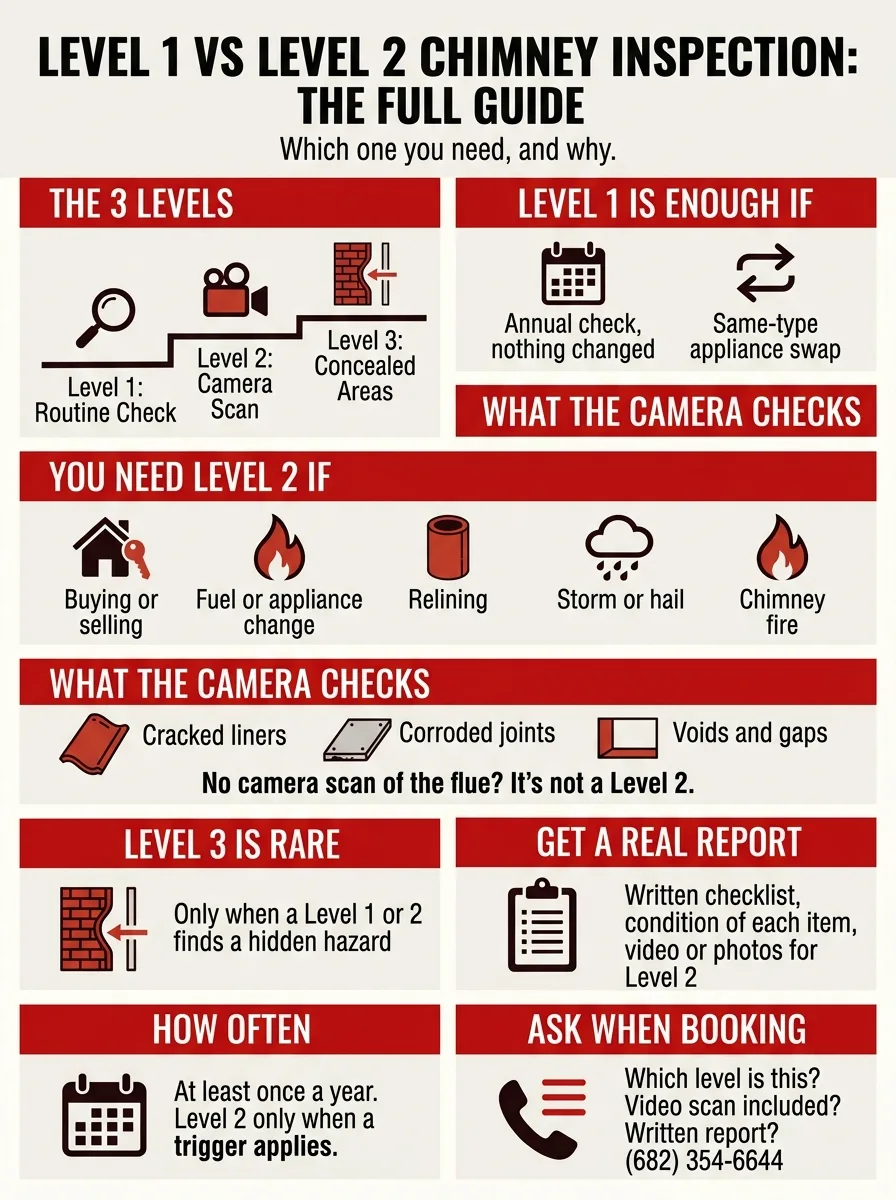
Level 1 vs. Level 2 vs. Level 3 at a Glance
The three levels are defined in NFPA 211, the national standard for chimneys, fireplaces, and vents. Each level includes everything in the levels below it.
| Level 1 | Level 2 | Level 3 | |
|---|---|---|---|
| Best for | Unchanged system in routine use | A change, a sale, or possible damage | A suspected hidden hazard |
| Reaches | Readily accessible areas | Level 1 plus attics, crawlspaces, and basements | Levels 1 and 2 plus concealed areas |
| Inside the flue | Visual check of what’s reachable | Video scan of every flue | Included |
| Camera | Not required | Required (video scan or equivalent) | Included |
| Invasive | No | No | Yes |
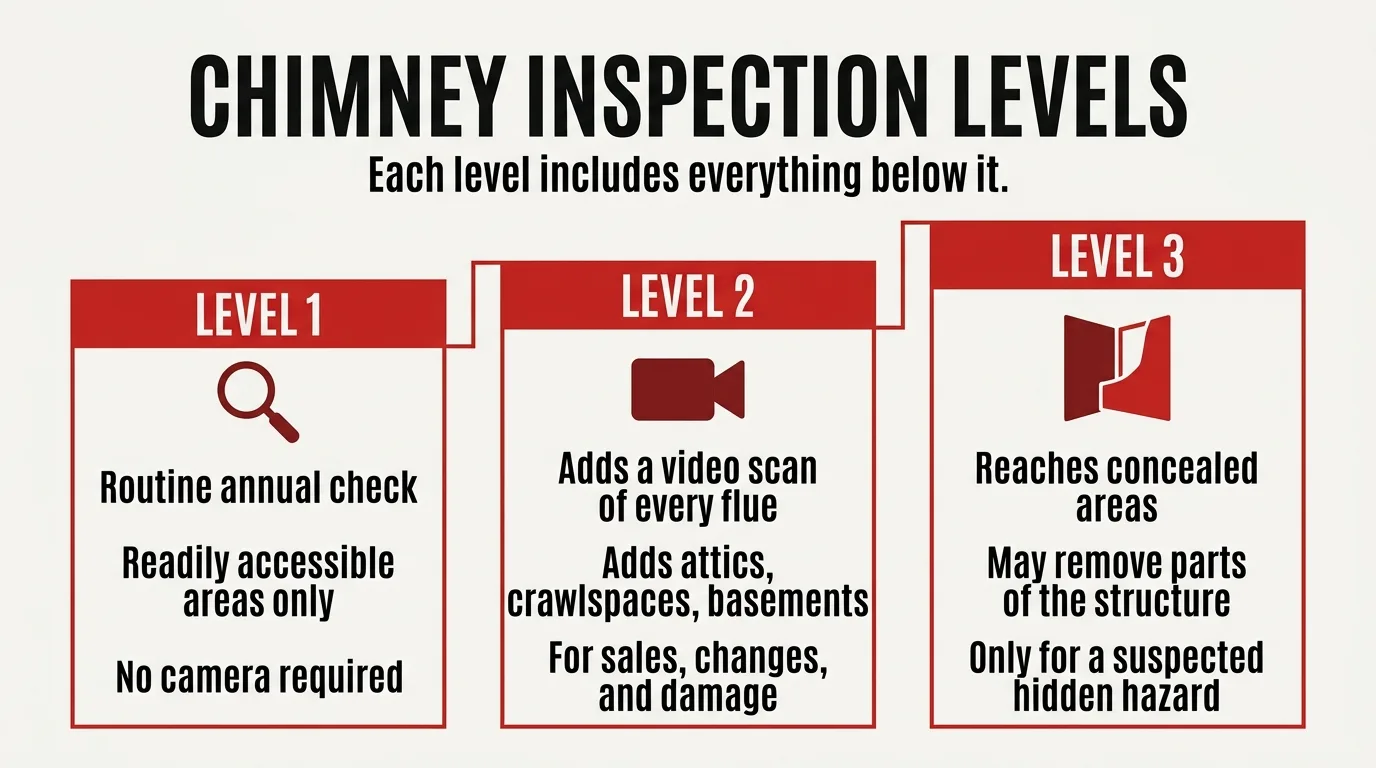
Which Level Do You Need? A Situation Guide
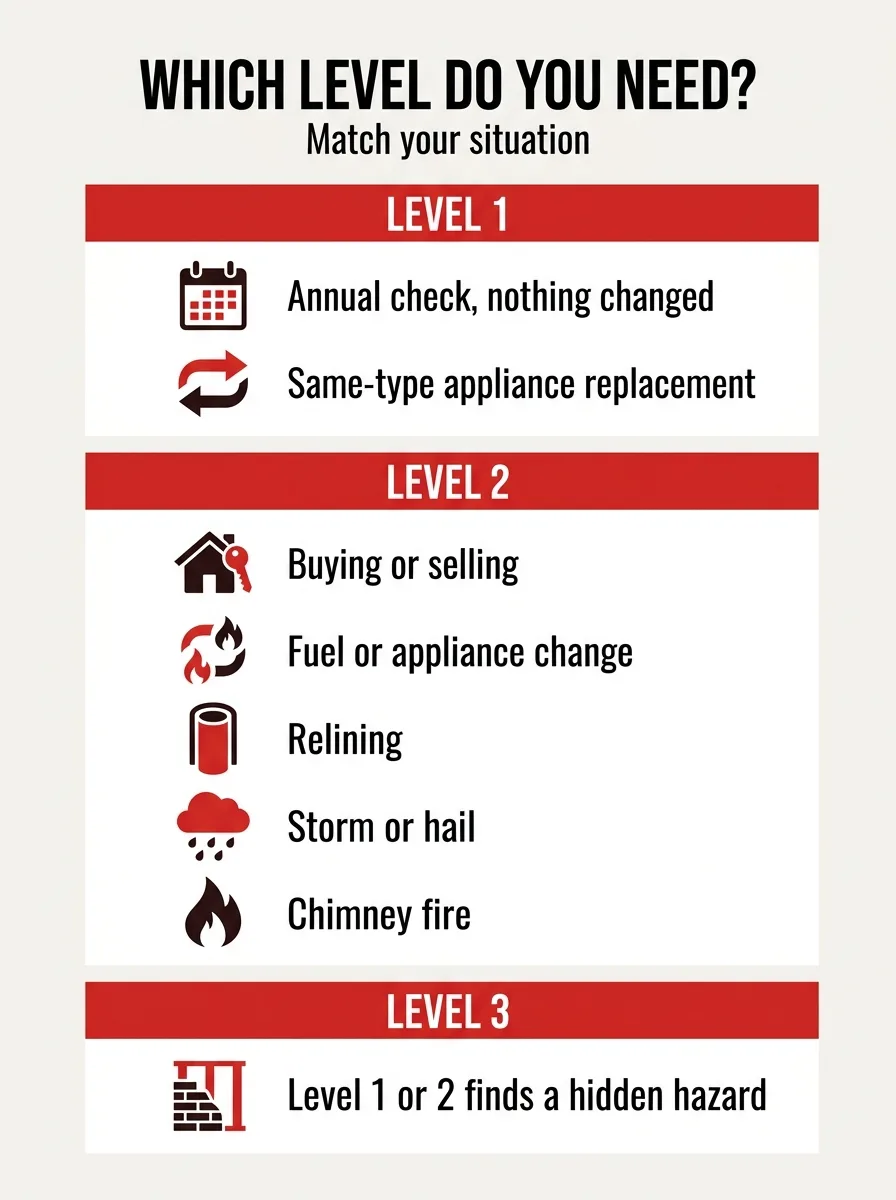
Match your situation to a level.
| Your situation | Level | Why |
|---|---|---|
| Annual check, nothing has changed | Level 1 | Routine service under the same conditions |
| Replacing an appliance with the same type | Level 1 | The chimney’s use stays the same |
| Buying, selling, or transferring a home | Level 2 | A sale is a named trigger |
| Adding an appliance, or swapping to a different type, rating, or efficiency | Level 2 | The chimney’s job has changed |
| Switching fuel, such as wood to gas | Level 2 | A fuel change is a named trigger |
| Relining, or changing the flue’s shape or material | Level 2 | The flue itself has changed |
| Chimney fire or building fire | Level 2 | Damage may be hidden |
| Storm, hail, or seismic event | Level 2 | Damage may be hidden |
| Operating malfunction, or a Level 1 that can’t confirm the system is safe | Level 2 | More detail is needed |
| A Level 1 or 2 points to a hidden hazard | Level 3 | Concealed areas must be opened |
Your situation isn’t on the list? Call (682) 354-6644 and we’ll tell you which level fits.
What a Level 1 Inspection Covers
Level 1 covers what’s readily accessible. That means parts you can reach without tools or ladders.
The technician verifies the chimney structure and flue are basically sound. They confirm the chimney is free of obstructions and combustible deposits, such as creosote, the tar-like byproduct of burning wood.
Level 1 also checks the basic appliance installation and the connection between the appliance and the chimney.
What a Level 1 Can Miss
Level 1 can’t show what’s inside the flue. Cracks and gaps in its protective lining stay hidden.
It also doesn’t reach concealed areas. Clearance problems and heat damage near the chimney can go unnoticed.
That’s why Level 1 fits only when nothing about the system has changed.
What a Level 2 Inspection Adds
Level 2 goes beyond a visual check. The technician opens access doors and panels using ordinary tools.
It also checks clearances to combustibles. These are the required gaps between the chimney and wood framing or other materials that can burn.
No demolition is involved. Nothing permanent is removed.
Why the Camera Matters
A Level 2 has to examine the inside of the flue. That’s what separates it from a Level 1.
It requires a video scan, also called a chimney camera inspection, or an equivalent method that shows the inside surfaces and joints. In practice, that means a camera. An inspection sold as a “Level 2” that never looks inside the flue doesn’t meet the standard.
The camera shows the flue liner, the protective lining inside the flue. It should show the full circumference clearly enough to reveal cracks, joint separation, and deposits. The Chimney Safety Institute of America describes each level’s scope in more detail.
Liner Types and What the Camera Finds
Different liners fail in different ways.
- Clay tile liners can crack.
- Stainless steel liners can corrode at their joints.
- Cast-in-place liners can develop voids.
The camera records each defect so it’s documented, not guessed at.
Liner Size and the Connected Appliance
A liner also has to suit the appliance connected to it. The inspector documents whether the size is correct.
A mismatch can affect how the appliance drafts.
Exterior Masonry, Crown, and Cap
Level 2 gives the exterior a closer look. The technician checks for spalling brick, failed mortar joints, and separation between the chimney and the house.
Spalling is when the face of a brick flakes or breaks away.
The crown, the concrete slab at the top of the chimney, and the cap, the metal cover over the flue, are checked too. Damage to either lets water in. See chimney cap installation if the cap needs replacing.
Attics, Crawlspaces, and Chases
Level 2 follows the chimney through the house. Those hidden areas are where a chase, the framed enclosure around the chimney, can hide gaps against the framing.
Water staining on joists and deteriorated insulation near the flue show up there too. The technician also confirms the clearances to combustibles described above.
See water stains on ceiling next to chimney if you’ve already noticed staining inside the house.
Multi-Flue Chimneys and Connected Appliances
A Level 2 covers every flue in the chimney. It also covers the appliances connected to them.
A chimney with two flues gets both scanned.
Masonry Chimneys vs. Factory-Built Fireplaces
Inspection procedures differ by construction. The CSIA publishes separate procedures for masonry fireplaces, masonry chimneys, and factory-built fireplaces.
A masonry chimney is built on site from brick or block. A factory-built fireplace is a prefabricated metal unit with a metal flue.
Access to a factory-built unit can require common tools to open panels. Tell the company which type you have.
What a Level 3 Involves
Level 3 goes further than Level 2. It reaches concealed parts of the chimney and flue by removing permanently attached parts of the chimney or building as needed.
A Level 3 isn’t routine. It’s recommended only when a Level 1 or Level 2 points to a hidden hazard that can’t be evaluated any other way.
Level 2 When Buying or Selling a Home in Fort Worth
For buyers, a Level 2 shows the real condition of the liner before closing. A hidden crack in the flue is a fire and carbon monoxide risk you’d otherwise inherit.
For sellers, it shows the chimney’s condition before a buyer’s inspector does. Problems found on your timeline are easier to handle than problems found during negotiation.
Level 2 After a Storm, Hail, or Chimney Fire
A Level 1 can miss damage inside the flue after a fire or weather event. A Level 2 checks for it.
If a chimney fire is happening now, get everyone out and call 911 first. After a fire, don’t use the fireplace again until a Level 2 has been done.
Hail is a recurring reason in Fort Worth. See chimney leaking after hail for what storm damage looks like from the outside.
Relining, New Appliances, and Fuel Changes
Changing what the chimney serves changes what it has to handle. Relining changes the flue’s shape or material. A new appliance or fuel changes what the flue carries.
See chimney relining for that service. A Level 2 confirms the existing chimney can handle the change.
What a Proper Inspection Report Includes
You should receive a written report. It should include a checklist and note the condition of each item inspected.
For a Level 2, the video or photos of the flue give the report its evidence. A one-line note on an invoice isn’t a report.
NFPA 211 doesn’t dictate the report format. A good inspector provides one anyway.
Using an Inspection Report for an Insurance Claim
A written report with video or photos can help document storm damage. Insurers often ask for documentation before approving a claim.
Confirm what your insurer requires. See documenting hail damage for an insurance claim for what to gather.
If the Inspection Finds Problems
The report lists what was found and what to do about it. Some findings need repair. Others need a sweep or relining first.
A hidden hazard that a Level 1 or 2 can’t evaluate leads to the Level 3 described above. See chimney repair for repairs, or how to repair a leaking chimney for leak findings.
How Long Each Level Takes
Times vary by chimney. Roughly, a Level 1 with a sweep runs 45 to 60 minutes. A Level 2 with a sweep runs about 1.5 to 2 hours.
The video scan and the attic or crawlspace access account for the extra time.
Inspection vs. Sweep
A sweep cleans the chimney. An inspection evaluates its condition.
They’re different services, and they’re often done in the same visit. See chimney sweep for what a cleaning covers.
How Often to Get Each Level
NFPA 211 calls for every chimney, fireplace, and vent to be inspected at least once a year. That annual inspection is normally a Level 1.
A Level 2 is event-driven, not scheduled. You get one when a trigger applies.
Even a chimney you never use needs the annual check. Animals nest in unused flues, and moisture damages liners regardless of use.
NFPA 211, Building Codes, and Local Rules
NFPA 211 is a safety standard, not a law by itself. Building codes often reference it.
Local rules can differ. A good technician knows the codes that apply in your area.
How to Prepare for Your Inspection
Clear the area around the fireplace or stove. Make attic and crawlspace access available.
Tell the technician about any changes or events, such as a new appliance, a storm, or a fire. Share earlier inspection reports if you have them.
What to Say When Booking
Tell the company why you’re calling. “Annual check, nothing changed” points to Level 1. “Buying a house” or “hail hit last week” points to Level 2.
Ask three questions. Which level is this? Does it include a video scan of the flue? Will I get a written report?
Also ask whether the technician is CSIA certified. CSIA Certified Chimney Sweeps are tested on all three inspection levels.
Why This Matters More in Fort Worth
Hail is a recurring trigger here. A storm can crack a crown or damage a liner in ways a ground-level check can’t see. Fort Worth’s clay soil and freeze-thaw cycles add stress over time.
Older masonry chimneys in neighborhoods like Fairmount, Ryan Place, and Mistletoe Heights are more likely to have liner problems that only a camera reveals. That’s a strong reason to choose a Level 2 when buying in those areas.
When to Call a Professional
Call when you’re buying or selling, after a fire or storm, or when anything about the chimney has changed. Also call if you can’t remember your last inspection.
A chimney inspection confirms your chimney’s condition at the right level. If the liner is damaged, see chimney relining.
Ready to book the right level? Call (682) 354-6644.