
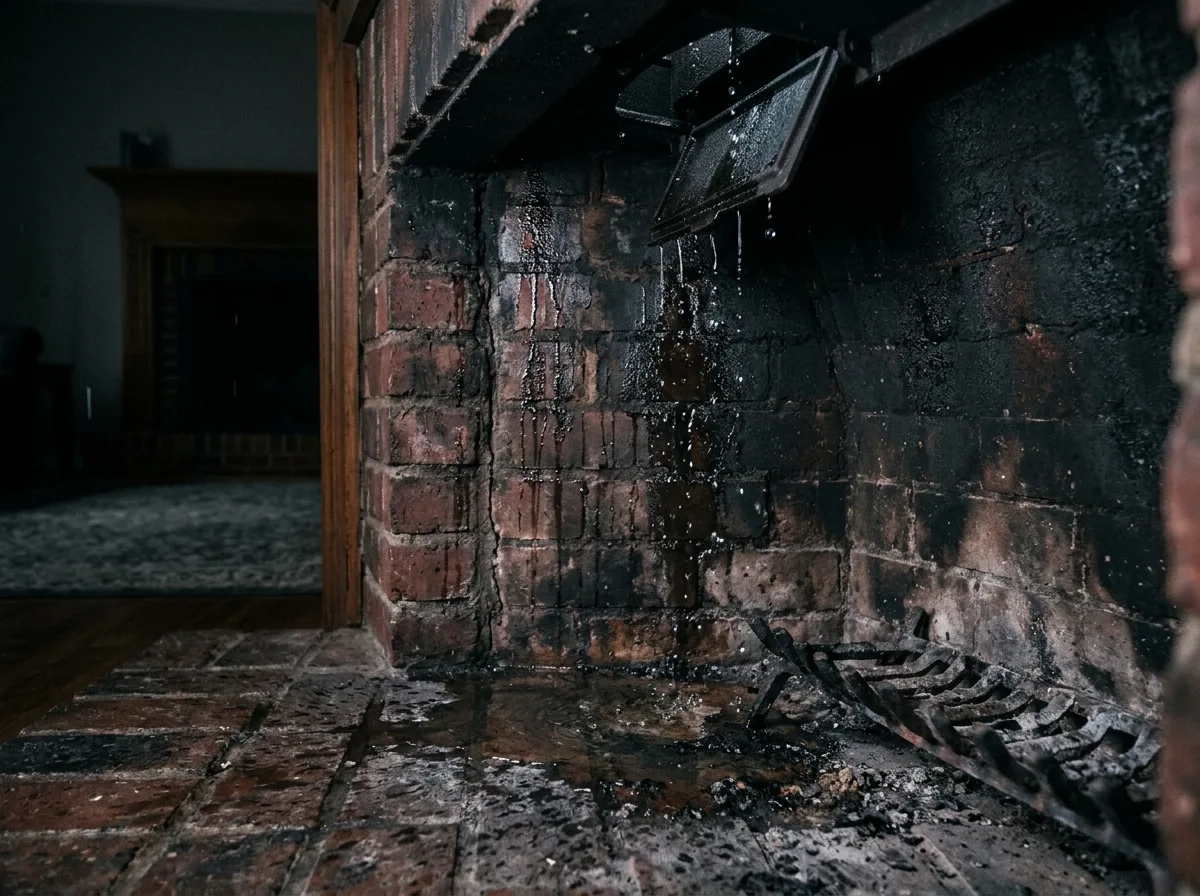
Water dripping from a chimney comes from six sources: the cap, the crown, the flashing, porous masonry, a rusted chase cover, or condensation inside the flue. Where the water shows up points to which one. Stains and drips in your Fort Worth home often sit away from the real entry point.
Protect your home first. Then match your drip to the table below.
Want the entry point found? Chimney Sweep Pro can help. Call (682) 354-6644.
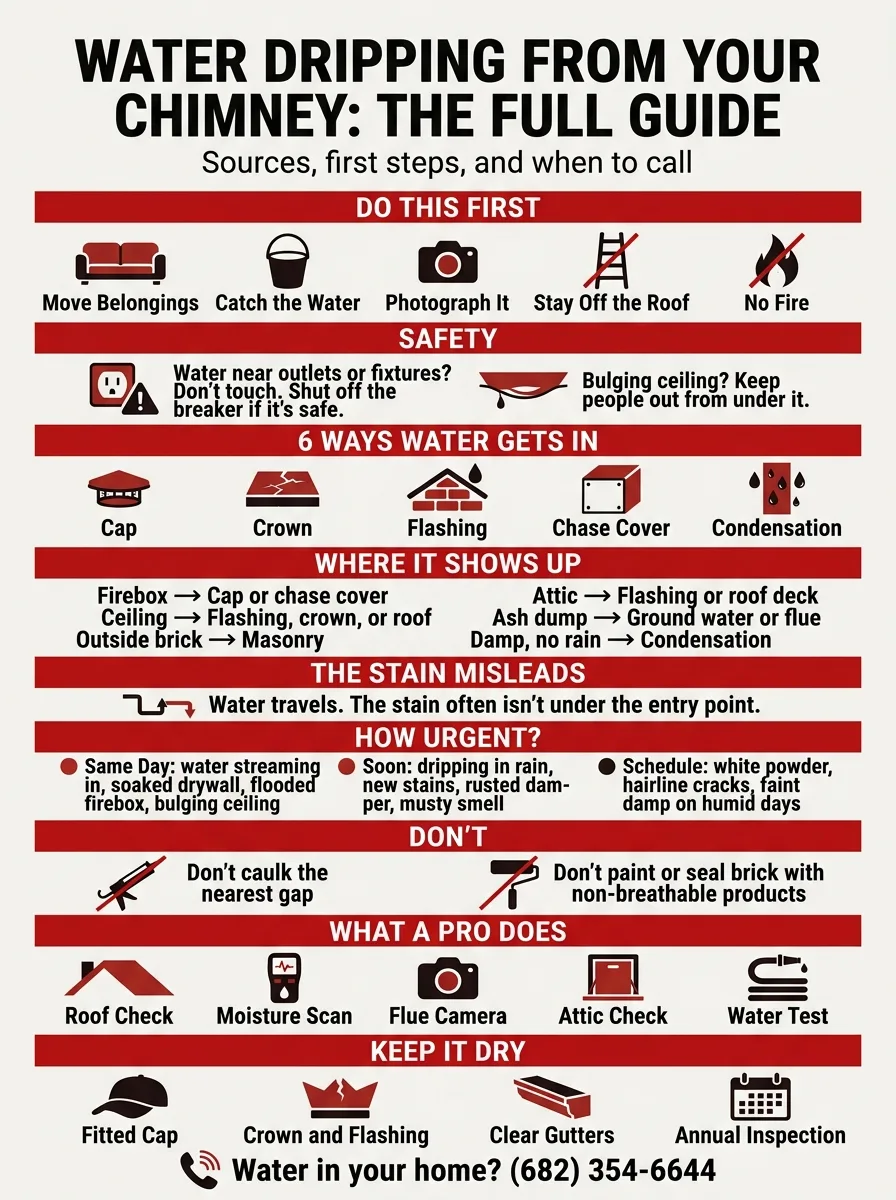
What to Do Right Now
- Move furniture and belongings away from the drip.
- Catch the water with a bucket or towels.
- Photograph the drip, the stain, and any visible damage.
- Stay off the roof.
- Keep the fireplace unlit until it’s been checked.
If water is near a light fixture, outlet, or switch, don’t touch it. Shut off power to that area at the breaker, if it’s safe to reach.
A bulging or sagging ceiling can give way. Keep people out from under it.
The Six Ways Water Gets In
- Cap: the metal cover over the flue opening. A missing or damaged cap lets rain fall straight in.
- Crown: the concrete slab at the top of the chimney. Cracks let water into the masonry.
- Flashing: the metal strips that seal the joint between the chimney and the roof. Gaps let water run down the chimney.
- Porous masonry: brick and mortar absorb water. Worn mortar joints let more in.
- Chase cover: the metal cover over the top of a prefabricated chimney’s enclosure. It can rust or split at the seams.
- Condensation: water vapor that cools into liquid inside the flue, the passage that carries smoke out.
More than one source is common.
Where the Water Shows Up Tells You Where to Look
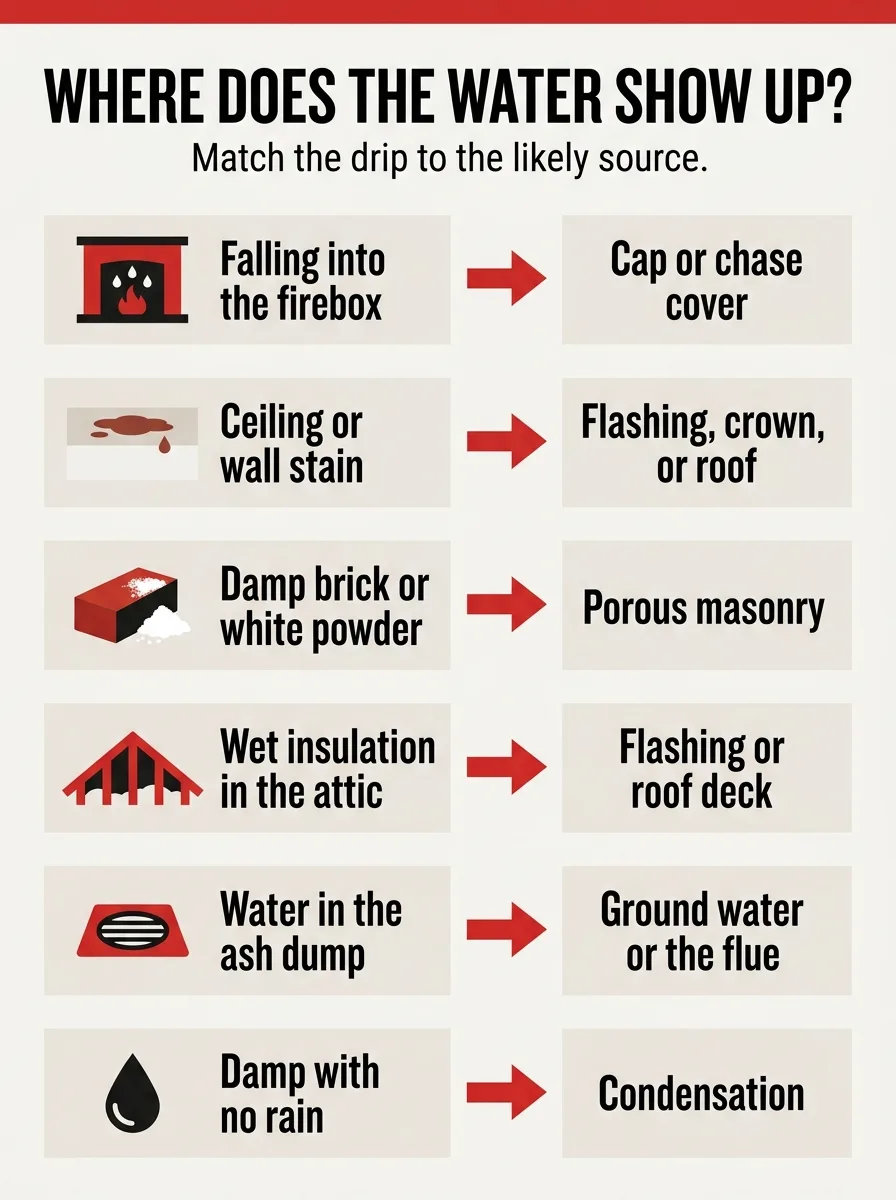
| Where you see water | Likely source | First thing to check |
|---|---|---|
| Falling into the firebox during rain | Missing or damaged cap, or a rusted chase cover | Look up the flue with a flashlight from the firebox. Check the damper |
| Stain or drip on the ceiling or wall near the chimney | Flashing, crown, or the roof | Note where the stain is. Don’t assume the source is directly above |
| Damp brick or white powder on the outside | Porous masonry or failed mortar | Look for crumbling mortar and flaking brick from the ground |
| Damp insulation or wet wood in the attic beside the chimney | Flashing or the roof deck | Look from the attic hatch with a flashlight |
| Water pooling in the ash dump | Ground water, or water down the flue | See the ash dump section below |
| Dampness with no rain, especially with a gas appliance | Condensation | Note whether it follows the appliance running |
Water Dripping Into the Firebox During Rain
Water falling into the firebox during rain usually means the flue is open at the top. A missing or damaged cap is the most common reason.
A rusted chase cover or a cracked crown can do the same. A closed damper may limit how much water reaches the room. It doesn’t stop the leak.
See chimney cap installation if the cap is missing or damaged.
Stains and Drips on the Ceiling or Walls
Water follows gravity along the masonry, the framing, and the back of the firebox. It can travel several feet before it shows.
A ceiling stain rarely sits under the entry point. Flashing, the crown, and the roof around the chimney are the usual sources.
See water stains on ceiling next to chimney for what to check on the ceiling itself.
Water Running Down the Outside or White Powder on the Brick
Brick and mortar are porous. They absorb rain like a sponge, and worn mortar joints let more in.
Water that freezes inside the masonry expands. That widens cracks and lets in more water.
White chalky powder on the brick is called efflorescence. It means water is moving through the masonry.
Water in the Attic Beside the Chimney
The attic shows where water ends up. Damp insulation, dark stains, or wet wood beside the chimney point to the flashing or the roof deck, the plywood layer under the shingles.
Look from the attic hatch with a flashlight. Don’t walk on the insulation or between the joists.
Photograph what you see. It helps the technician and any insurance claim.
Water Pooling in the Ash Dump
Some fireplaces have an ash dump, a compartment below the firebox that collects ashes, often with a clean-out door near the base of the chimney.
Water there doesn’t always come from above. It can seep in from the ground around the foundation.
If you find no stains or water tracks coming down from above, ground water is a possibility. A professional can tell the two apart.
Condensation Inside the Flue
Condensation is water vapor turning to liquid on a cool surface. Burning gas produces water vapor.
In a flue that’s oversized or poorly insulated, that vapor cools and condenses into water. Suspect condensation when water shows up without rain, especially with a gas appliance.
A camera check shows the liner and its size. A damp smell often comes with any moisture problem. See fireplace smells wet for that symptom.
Chimney Leak or Roof Leak?
Sometimes the chimney isn’t the source. A roof leak higher up can run down the rafters and drip beside the fireplace.
A chimney professional checks the cap, crown, flashing, and masonry. A roofer checks the shingles and underlayment. See how to repair a leaking chimney for how to tell which one applies.
Gutters and Drainage Overloading the Chimney Base
Clogged gutters spill water against the chimney base and the flashing area. That can overload the seal there.
Keep the gutters near the chimney clear. Trim overhanging branches so debris doesn’t pile up against the flashing.
Timing Clues
The timing of the drip gives hints. These are general patterns, not proof.
- Every time it rains: a direct opening, such as a missing cap or a cracked crown.
- Only in heavy or wind-driven rain: flashing, the masonry, or a chase-top shroud catching blown rain.
- Hours after the rain stops: water stored in saturated masonry or framing, working its way down.
Emergency or Can Wait?
Emergency, call the same day:
- Water streams into the living space.
- Drywall is soaked.
- The firebox floods.
- A ceiling bulges.
Soon:
- Dripping during rain.
- New ceiling stains.
- A rusted damper.
- A musty smell.
Schedule a visit:
- White powder on the exterior brick.
- Hairline cracks in the mortar.
- A faint damp smell only on humid days.
Active water in your home? Call (682) 354-6644.
Signs of a Serious Leak
- A musty smell near the fireplace.
- Orange rust on the damper or inside the firebox.
- Brown rings or stains on ceilings and walls around the chimney.
- Dripping sounds during or right after rain.
- Crumbling mortar or flaking brick.
- Peeling paint near the chimney.
Fuzzy growth means mold. See mold in fireplace for what to do.
What Happens If the Water Keeps Coming
Water that keeps entering rots the roof deck, ceiling joists, and wall studs. Framing rot leads to sagging ceilings.
Moisture trapped behind drywall grows mold. The EPA’s guide to mold, moisture, and your home covers moisture control and mold basics.
See how to repair a leaking chimney for what delay does to the chimney itself.
What You Can Check Yourself
From inside the house and the ground, you can look for stains, rust, and damp spots. You can look up the flue with a flashlight from the firebox. You can check the gutters near the chimney from the ground.
Don’t go on the roof, and don’t open the chimney enclosure. Don’t poke at the flue.
Don’t caulk the nearest visible gap. The gap you can see may not be the source, and sealing the wrong spot doesn’t stop the water.
What a Professional Does
A technician goes on the roof to check the cap, crown, flashing, and masonry. A moisture meter scan of the walls, ceiling, and framing around the chimney maps where the water has traveled.
A camera scan of the flue shows cracks, liner joint gaps, and water tracks inside. An attic check catches damp insulation and roof deck damage early.
If the source isn’t obvious, a water test isolates one area and runs water on it to see what happens inside. See chimney inspection for what an inspection includes.
Insurance and Storm Damage
Sudden storm damage is more likely to be covered than gradual wear. Coverage depends on your policy.
Ask your insurer what documentation it needs. Photographs, the storm date, and an inspection report help.
See chimney leaking after hail for how to document storm damage.
Preventing Drips
- Have the chimney inspected every year.
- Keep a properly fitted cap on the flue.
- Keep the crown and flashing in good condition.
- Keep gutters clear and branches trimmed back.
- Use only a vapor-permeable water repellent on brick. Paint and non-breathable sealers trap moisture inside the masonry.
The Chimney Safety Institute of America notes that water causes more damage to masonry chimneys than fire does. See its water damage prevention tips.
See chimney cap installation for the most common preventive fix.
Why This Shows Up More in Fort Worth
Fort Worth’s spring storms bring wind-driven rain and hail. Both test the cap, crown, and flashing.
North Texas gets enough freezing nights for freeze-thaw damage. Clay soil that shifts with moisture also stresses the chimney over time.
Older masonry chimneys in neighborhoods like Fairmount, Ryan Place, and Mistletoe Heights see the most wear. Age makes each of these factors more likely to cause an active leak.
When to Call a Professional
Call if water actively drips, stains appear on the ceiling, a musty smell develops, or you see rust in the firebox or crumbling brick outside. Call the same day if water is entering your living space.
A chimney inspection finds the entry point. Chimney leak repair fixes it.
Ready to stop the drip? Call (682) 354-6644.