
To measure for a chimney cap, you need the outside size of the flue tile and how far it rises above the crown, or for a chimney with several flues, the crown and the flues together. Those numbers come from the top of the chimney, which is roof work, so a professional takes them.
This post shows what a professional measures and how to check the numbers on a Fort Worth quote.
Want the right size without climbing up? Chimney Sweep Pro can measure it. Call (682) 354-6644.
What size chimney cap do I need?
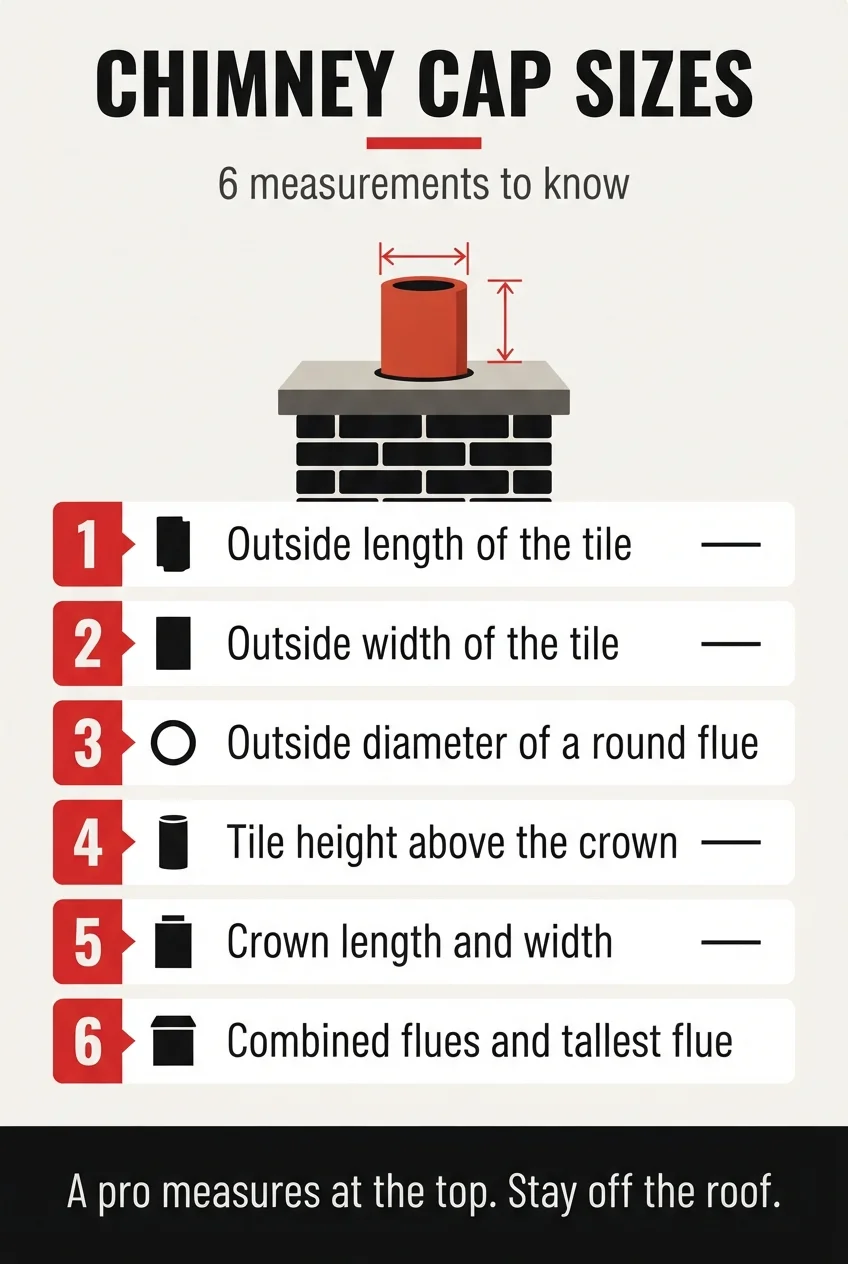
A single-flue cap is sized from the outside length and width of the flue tile, or the outside diameter of a round flue, plus how far the tile rises above the crown, while a multi-flue cap is sized from the crown and the combined flues. A professional takes these measurements at the top of the chimney.
The flue is the passage that carries smoke out of the house, and the flue liner is the clay tile or metal pipe that lines it.
The crown is the concrete or mortar slab that tops a masonry chimney.
What is a chimney cap measured against?
A cap is measured against whatever it sits on or covers: the flue tile, a metal liner, the crown, or the chase. The right one depends on the cap style.
- Flue tile: the clay tube that rises above the crown. Single-flue caps usually fit over or around it.
- Metal liner: a stainless steel pipe. Its outside edges are measured the same way as a tile’s.
- Crown: the slab at the top. Multi-flue and top-mount caps are measured against it.
- Chase: the framed box, often wrapped in siding, that surrounds a factory-built chimney. Its cover is sized to the whole box.
On a factory-built chimney, the cap fits the round flue pipe, and the chase cover is a separate part. Our guide to chimney cap vs chase cover explains the difference.
How to measure for a chimney cap: 6 measurements
Measure the outside edges of the exposed flue tile or metal liner, length and width for a square or rectangular flue and diameter for a round one, then record how far the tile rises above the crown. These numbers come from the top of the chimney, so a professional takes them.
Six measurements cover the common cap styles. The table shows what each one is and which caps use it.
| Measurement | What it is | Cap styles that use it |
|---|---|---|
| Outside length of the flue tile | The longer outside edge of a square or rectangular tile | Single-flue and outside-mount caps |
| Outside width of the flue tile | The shorter outside edge of the same tile | Single-flue and outside-mount caps |
| Outside diameter of a round flue | The width across the outside of a round tile or liner | Round single-flue and clamp-on caps |
| Tile height above the crown | How far the tile rises above the slab | Bolt-on single-flue caps |
| Crown length and width | The outside size of the concrete or mortar slab | Multi-flue and top-mount caps |
| Combined flues and tallest flue | The total span of the flues and the height of the tallest one | Multi-flue caps |
Outside length and width of the flue tile
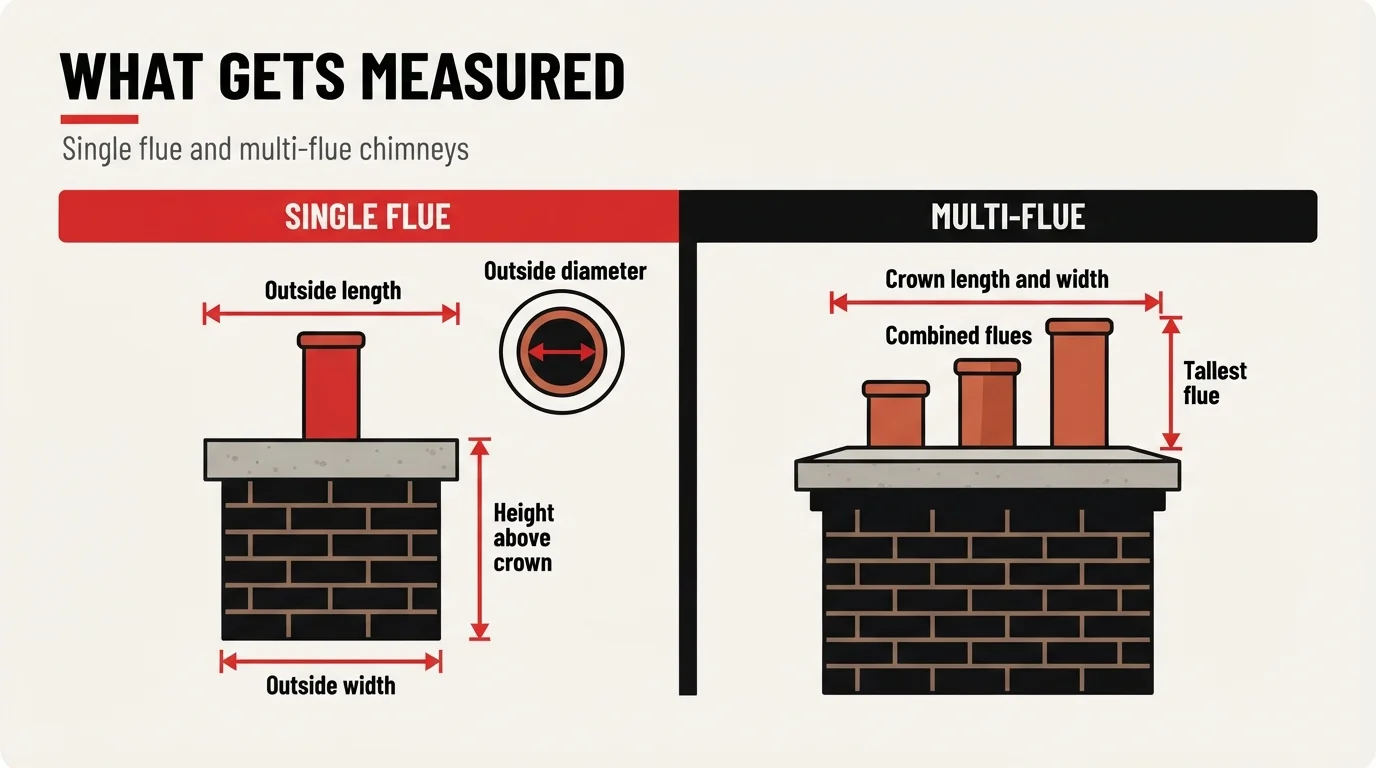
Measure the outside edges of the exposed tile, not the opening inside it. Take the length and the width on a square or rectangular flue.
A single-flue cap seats over or around the tile. The tile’s outer size decides whether the cap fits.
Outside diameter of a round flue
On a round flue or metal liner, measure the outside diameter. Round caps clamp around the pipe with a stainless steel band, so the outside size sets the fit.
Tile height above the crown
Measure how far the tile rises above the crown, because bolt-on caps need enough tile to grip. One maker says about 1.5 inches, and another guide says at least 2 inches.
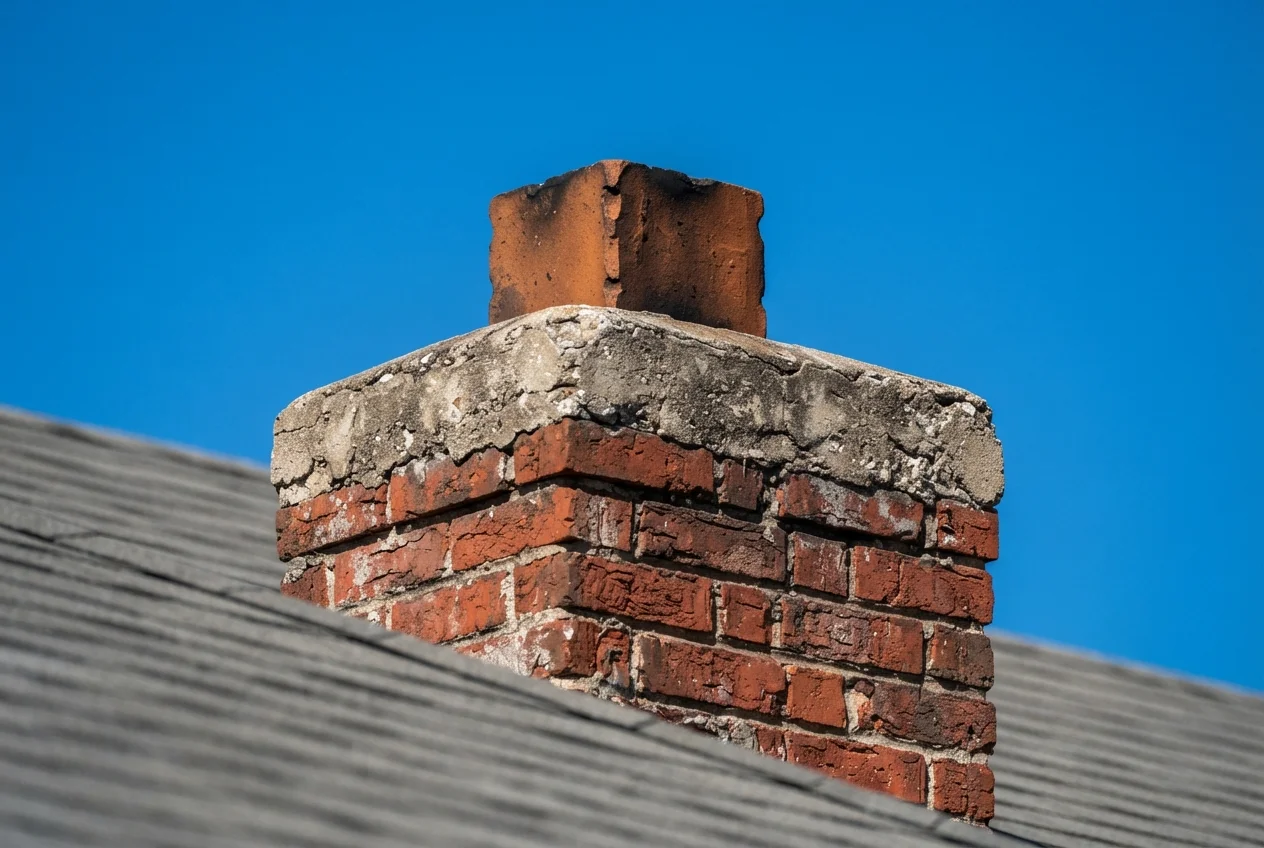
If the tile rises less than the maker requires, the cap needs a leg kit, a set of legs that holds the cap on a flue with no tile sticking up. The length and width of the opening are measured instead.
Crown length and width
Multi-flue caps are sized to cover the crown, so its length and width set the outer size of the cap. The cap also has to clear every flue underneath it.
Top-mount caps screw into the crown, so the crown’s size and condition matter too.
Combined flues and the tallest flue
On a chimney with several flues, measure the combined width and height of the flues. Use the tallest flue for height and the widest for width, so one cap covers all of them.
The tallest flue also sets the clearance under the lid, covered below.
Which measurements does each chimney cap type need?
Each cap style attaches differently, so each one needs its own measurements. The table matches the styles in our guide to chimney cap types to what gets measured.
This Old House describes how the common cap styles attach.
| Cap type | What gets measured | Why |
|---|---|---|
| Single-flue cap on the tile | Outside length and width, or diameter, and tile height above the crown | It seats over the tile and bolts at the corners |
| Outside-mount cap | Outside length and width, or diameter, of the tile | It clamps or bolts to the outside of the tile |
| Top-mount cap | Crown length and width, and the flue opening | It screws into the crown masonry |
| Slip-in cap | Inside size and shape of the flue opening | It fits down into the opening |
| Multi-flue cap | Crown length and width, combined flues, and the tallest flue | It covers the entire crown |
| Chase cover on a prefab chimney | Outside size of the chase and the flue pipes passing through | It seals the top of the whole chase |
Top-sealing damper units are sized to the flue as well, as covered in our guide to top-sealing damper vs chimney cap.
How much taller than the flue should a cap be?
Guides call for several inches of clearance between the cap’s lid and the top of the flue, with one contractor citing at least 6 inches for a single flue and 5 inches over the tallest flue of a multi-flue cap. Follow the cap maker’s instructions, because the right gap also protects screen area.
The gap between the lid and the flue top is where air and smoke leave. A gap that is too small can slow the draft.
Why does chimney cap size affect screen area?
The model residential code asks for screen open area of at least four times the flue outlet, so a cap that fits the tile still needs enough open screen. A taller or wider cap adds area.
The flue outlet is the opening at the top of the flue. Screen openings also have to pass the sphere test the model code sets for spark-arrestor mesh.
How much bigger than the flue can a cap be?
One contractor says a cap can exceed the flue dimensions by up to 1 inch and still fit, and some caps adjust to a range of flue sizes. A cap that is too far off leaves gaps or cannot seat, so ask the maker for the stated range.
Use the maker’s stated range, not a guess.
What happens if a chimney cap is the wrong size?
A cap that is too small or loose leaves gaps that let rain and animals in, rattles in wind, and is more likely to blow off. A cap with too little clearance over the flue can also slow the draft, so size affects airflow as well as fit.
- Gaps: rain, animals, and debris get past the cap.
- Blow-offs: a loose cap can lift in wind, and our guide to a chimney cap that blew off covers what to do next.
- Rattling: a loose cap shakes in wind, which is one of the signs a chimney cap needs replacing.
- Open flue: a cap that comes off leaves the chimney exposed, as our guide to a chimney without a cap explains.
Unsure whether your cap fits? Chimney Sweep Pro can check. Call (682) 354-6644.
What can you check from the ground?
From the yard you can count flues, note their shape, and look at the cap you have, but you cannot get cap-ready measurements. Use binoculars or a phone zoom, and stay off the roof.
- Count the flues: one flue points to a single-flue cap, and more than one often points to a multi-flue cap.
- Note the shape: round, square, or rectangular.
- Look at the cap you have: does it sit on the tile, bolt to the crown, or look custom-made?
- Take photos: zoom in from a few angles and keep them for the professional.
- Check your paperwork: an old inspection report or invoice may list the cap.
- Write down problems: rattling, rust, gaps, or a cap that leans.
Do not order a cap from a ground estimate. A cap that looks right on a screen can fail on the roof.
Why can’t you measure a chimney cap from inside the fireplace?
Measurements from inside miss the outside of the tile, the crown, and the tile’s height above it, which are the numbers a cap needs. The damper opening is also usually narrower than the flue above it, so it does not show the flue’s real size.
The flue can change shape or direction on the way up. Only the top shows what the cap must fit.
What measuring mistakes lead to the wrong cap?
Most wrong-size caps come from five mistakes, and each one traces to measuring the wrong part or the wrong place.
- Measuring inside the tile: caps are sized from the outside edges.
- Measuring the old cap: the old cap may have been the wrong size.
- Ignoring the tile height: a short tile changes the mounting method.
- Measuring one flue on a multi-flue stack: the cap must cover all of them.
- Mixing up round and square: a round flue needs a diameter, not a length and width.
How do you check a professional’s chimney cap measurements?
Ask for the numbers behind the quote: the tile’s outside length and width or diameter, its height above the crown, and for a multi-flue stack the crown and the tallest flue. A professional who measured at the top can give you all of them.
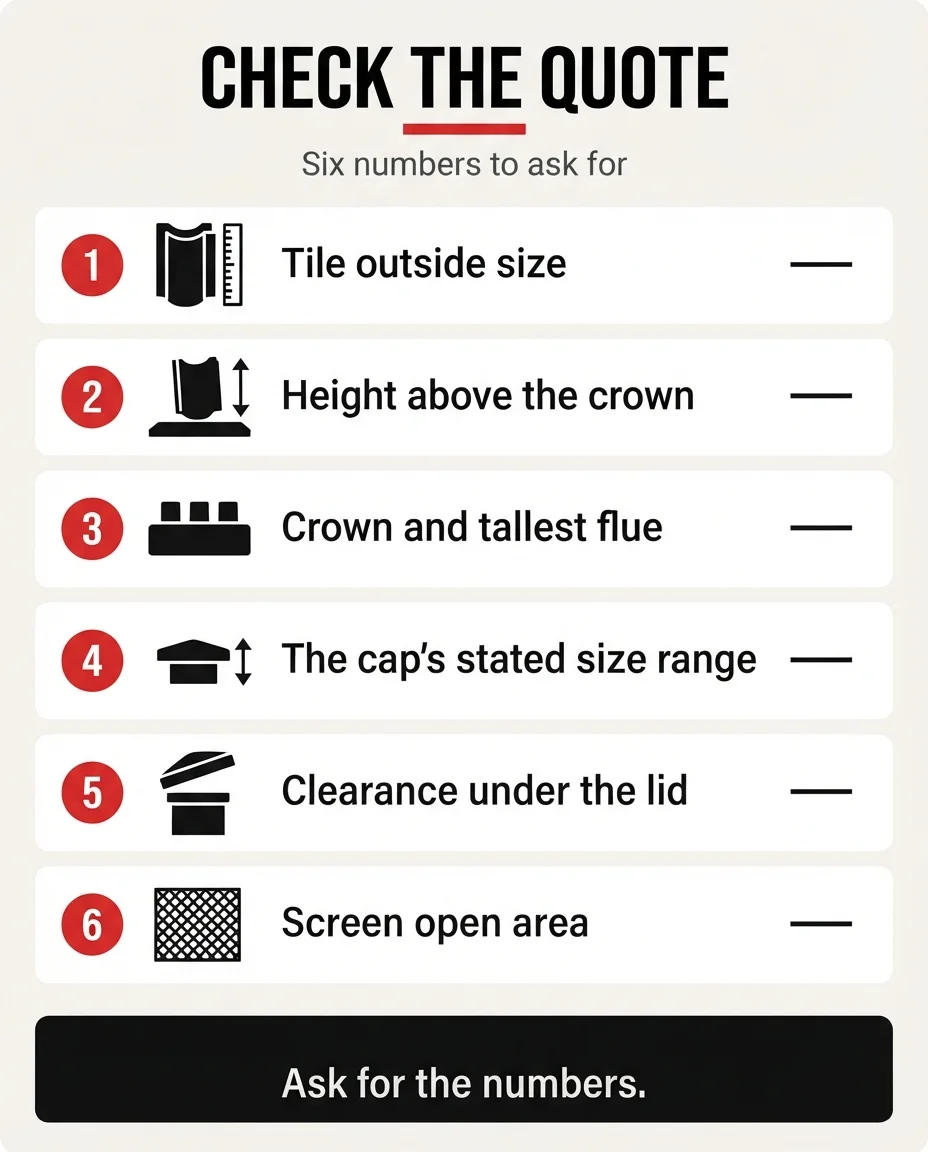
- The cap’s stated size range: the maker prints it in the specifications.
- Whether a leg kit is needed: that depends on the tile height.
- The screen’s open area: it should meet the code that applies to your chimney.
- The clearance under the lid: it should match the maker’s instructions.
Price depends on the metal, the size, and the labor, and the factors are laid out in our post on chimney cap installation cost.
What if a standard cap does not fit?
A standard cap does not fit when the flue is off-square, the tile barely rises above the crown, or several flues share one crown. Those chimneys often need a custom cap or a leg kit.
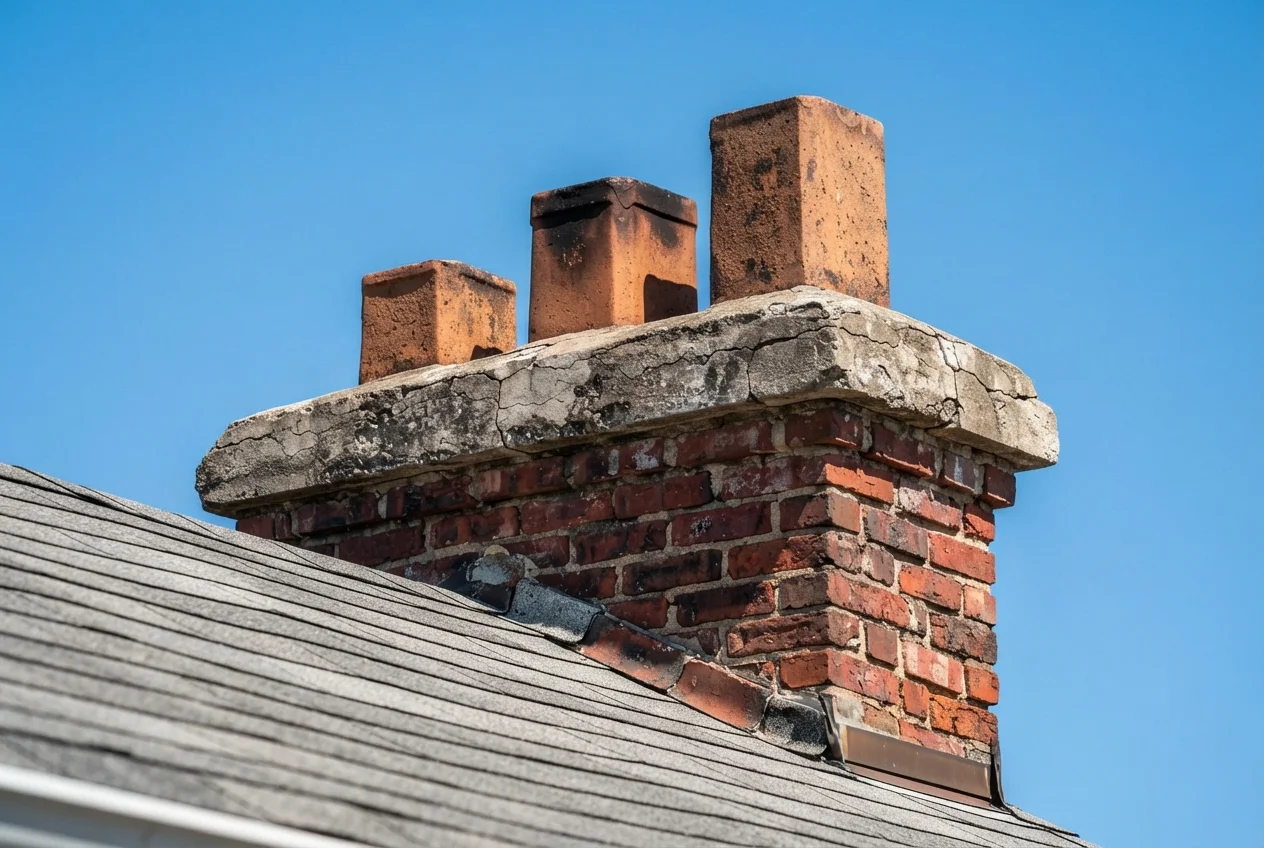
A multi-flue cap is custom-sized to cover the entire crown. A professional builds it from the crown and flue measurements.
Chimney cap sizes in Fort Worth homes
Fort Worth housing and weather change which size problems come up.
Older homes in Fairmount
Older homes in Fairmount can have flues that are off-square, low above the crown, or grouped in a stack with more than one flue. Caps there are more often custom-made.
Newer homes such as Benbrook
Newer homes in neighborhoods such as Benbrook more often have round factory-built flue pipes. The cap is sized to the pipe’s diameter.
Hail and storm winds
Hail and storm winds test every cap. A snug fit and sound fasteners matter most.
Summer heat
Summer heat expands and shrinks the metal every day. That cycle loosens fasteners, and a wrong-size cap rattles sooner.
What does a chimney professional do at a measuring visit?
A professional gets to the top of the chimney, measures the tile or liner, the crown, and the flues, and checks the crown and tile for damage before choosing a cap. The technician records the numbers so the cap can be built or ordered to fit.
If the crown is cracked or the tile is damaged, that repair comes with or before the new cap. A chimney inspection also shows whether the crown and tile are sound enough to take one.
Ask any chimney company whether its technicians hold CSIA certification. CSIA is the Chimney Safety Institute of America, a nonprofit that certifies chimney sweeps.
When to call a chimney professional
Call a professional when the cap is missing, loose, leaning, or rattling, when you need a new cap, or when your chimney has several flues or a short tile.
- Emergency: If a carbon monoxide alarm sounds, get everyone outside and call 911 before calling anyone else. Do the same for smoke or fire inside the house.
- Soon: A missing or loose cap, a cap that rattles in wind, and animal sounds in the flue belong here. Do not light a fire until a professional checks the flue.
- Can wait: Planning a replacement for a cap with surface rust and no loose parts can wait until your next inspection.
Counting flues and taking photos from the ground is a job you can do. Climbing a roof to measure is a fall risk, so leave it to a professional.
Chimney Sweep Pro handles chimney cap installation in Fort Worth and nearby cities such as Keller and Saginaw. For help with how to measure for a chimney cap, call (682) 354-6644 and we will measure your chimney.